





How the IB Curriculum Prepares Students for 21st Century Careers
The IB curriculum prepares learners for 21st-century careers by building transferable skills, critical thinking, research, communication, collaboration, digital literacy, and adaptability through inquiry-based learning. Learners practise university-level research in the IB Diploma Programme Extended Essay (EE), learn to evaluate information and bias in the Theory of Knowledge (TOK), and build leadership and empathy through CAS and community projects. The IB Career-related Programme (IBCP) adds real-world exposure through career-focused study and hands-on learning. Together, these experiences help learners solve problems, communicate clearly, and thrive in fast-changing fields like AI, sustainability, global business, and digital media.
Table of Contents
- Core Components of IB
- Inquiry-Based Learning Approach
- Skills Required for 21st Century Careers
- Critical Thinking and Problem Solving
- Communication and Collaboration
- Digital Literacy and Adaptability
- How IB Builds Career-Ready Skills
- Research Through Extended Essay
- Theory of Knowledge and Analytical Thinking
- CAS and MYP Community Projects for Real-World Exposure
- Understanding the IB Career-related Programme
- Global Recognition and University Readiness
- How IB Components Build 21st Century Career Skills
- Emerging Career Opportunities After IB
- Conclusion
- FAQs
Core Components of IB
The IB programme follows a holistic approach to learning that goes beyond academic skills. At the heart of IBDP, there are DP core components like Extended Essay, Theory of Knowledge, and Creativity, Activity, Service. These make sure that the learners are not just a receiver of knowledge but active participants in the process.
Each aspect serves a purpose. The EE develops research skills, the ToK enhances critical thinking, and the CAS promotes social awareness.
Inquiry-Based Learning Approach
Conventional educational methods and traditional curricula rely heavily on memorisation, whereas IB promotes a hands-on, project-based, inquiry-driven learning environment. It encourages learners to question established ideas and come up with their own conclusions. This helps instill a spirit of curiosity and independence, two qualities that are fundamental for success in today’s fast-changing industries.
This approach also promotes flexibility, which is important for adapting to a fast-changing workplace.
Skills Required for 21st Century Careers
Critical Thinking and Problem Solving
Career success today requires people who can evaluate situations and make informed decisions. Organisations need employees who look for innovative ways to solve problems. These are some of the skills that IB learners develop through research projects, case studies, and interdisciplinary learning.
Communication and Collaboration
Communication plays an important role in a globalised workforce. By engaging in presentations, group discussions, and projects, IB learners develop communication skills, explore ideas clearly, and work effectively in teams.
This practice prepares learners to deal with workplace situations, where teamwork is a requirement.
Digital Literacy and Adaptability
Technology is part of almost all the workplaces today. The IB curriculum is designed in such a way that learners become familiar with technology-related tools and software applications, helping them navigate technology easily. They become adept at adjusting to changing circumstances, a vital trait in this age of technological advancement.
How IB Builds Career-Ready Skills
Research Through Extended Essay
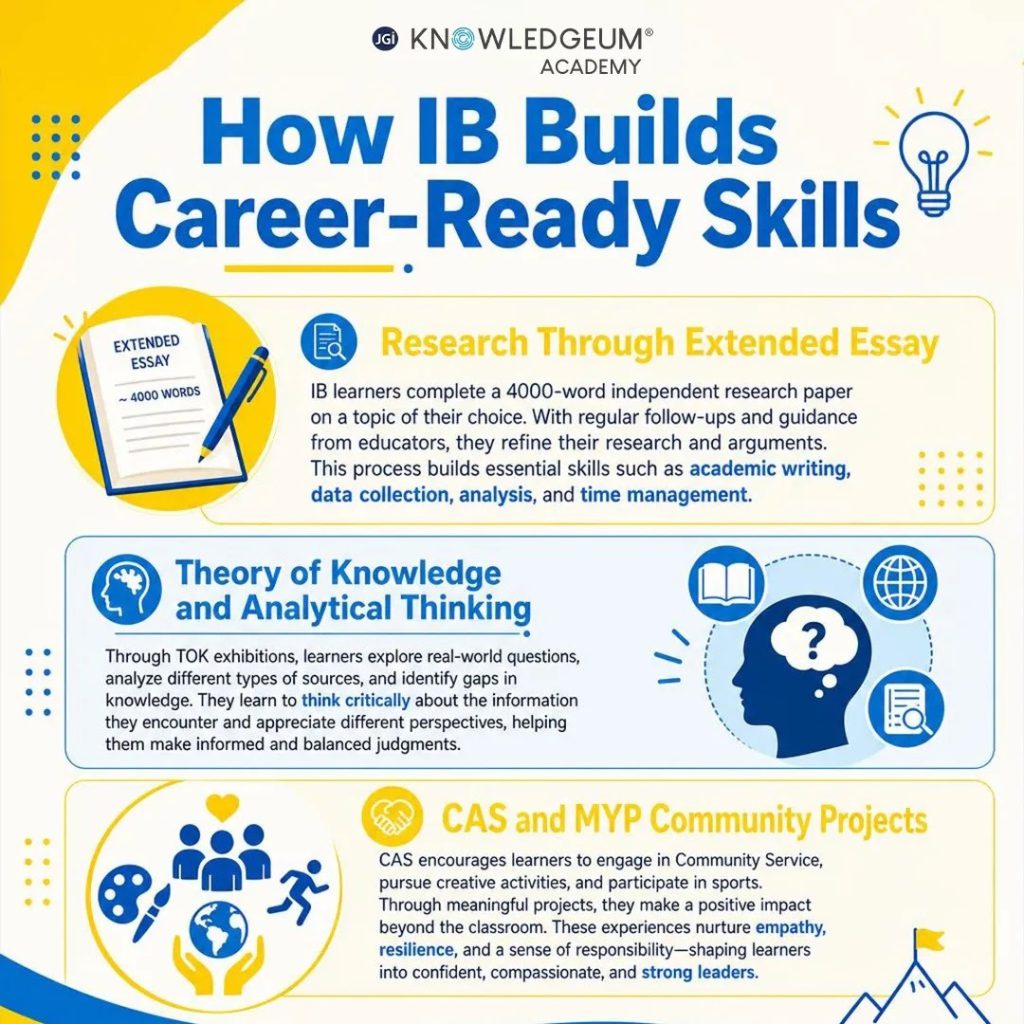
The Extended Essay is one of the DP core elements of the IB Diploma Programme. The learners choose a topic of their interest and write a 4000-word research paper. It helps IB learners gather information from relevant sources and analyse data. This process is similar to university-level research, and thus IB learners have a definite edge. It also develops skills like academic writing and time management, preparing them for professional life.
Theory of Knowledge and Analytical Thinking
The Theory of Knowledge is another DP core element that encourages learners to question the nature of knowledge itself. It prompts them to analyse sources, identify gaps, and think critically about information. In an age of misleading information, these skills are invaluable, as they help them differentiate between credible and non-credible information sources.
CAS and MYP Community Projects for Real-World Exposure
Through community service, creative activities, and sports, CAS takes learning beyond the classrooms. Learners receive first-hand experiences to help them become empathetic, resilient, and strong leaders. Such attributes are desired by today’s workforce, as emotional intelligence is a valuable skill.
MYP community projects encourage self-initiated learning processes. These projects sharpen skills like decision-making, communication, and reflection.
Understanding the IB Career-related Programme
The IBCP caters to those who are looking forward to pursuing a career-orientated programme. This programme integrates theoretical study along with practical learning experiences through career-related subjects. Learners who choose IBCP are career-ready with hands-on industry experience, which is appreciated for 21st-century careers.
Global Recognition and University Readiness
One of the benefits of the International Baccalaureate is its international recognition. Universities around the world recognise that IB learners have received a quality education and are skilled in a variety of areas.
According to the 2021 research summary*, 98% of IBDP learners aim for a minimum of a bachelor's degree, whereas 81% of learners strive for a master’s, doctoral, or professional degree. Top global universities understand how IB programmes help learners during higher studies to achieve better grades. This is because these learners are used to researching topics, writing research papers, and developing independent learning.
*Summary developed by the IB Research department based on a report prepared by Joshua Pretlow and Yihua Hong.
How IB Components Build 21st Century Career Skills
| IB Approach | What It Involves | Skills Developed | Career Relevance |
| Extended Essay (EE) | Independent 4000-word research project on a chosen topic | Research skills, analytical thinking, academic writing, time management | Prepares for university research, data analysis roles, and knowledge-based careers |
| Theory of Knowledge (TOK) | Exploration of how knowledge is constructed and evaluated | Critical thinking, reasoning, evaluation of sources | Helps in decision-making roles, consulting, policy-making, and research |
| Creativity, Activity, Service (CAS) | Participation in community service, creative and physical activities | Leadership, empathy, teamwork, resilience | Builds emotional intelligence required in management and people-centric roles |
| MYP Community Projects | Self-directed projects addressing real-world issues | Problem-solving, communication, reflection, initiative | Encourages innovation and prepares for entrepreneurial and social impact careers |
| Inquiry-Based Learning | Learning through questioning, exploration, and investigation | Curiosity, independent thinking, adaptability | Essential for dynamic industries like tech, research, and innovation-driven sectors |
| Collaborative Learning (Presentations & Group Work) | Group discussions, teamwork, and presentations | Communication, collaboration, interpersonal skills | Prepares for global workplaces and cross-functional team environments |
| Digital Literacy Integration | Use of digital tools, platforms, and research databases | Tech proficiency, adaptability, information literacy | Relevant for careers in AI, digital media, data science, and IT sectors |
| IB Career-related Programme (IBCP) | Combines academic study with career-focused, hands-on learning | Practical skills, industry exposure, professional readiness | Direct pathway to employment in fields like business, tech, and hospitality |
Emerging Career Opportunities After IB
The IB curriculum helps learners explore and dive deep into numerous career prospects, particularly in those emerging areas that need an interdisciplinary perspective. They are:
- Data Science and Artificial Intelligence
- Environmental Sustainability
- Global Business and Entrepreneurship
- International Relations and Policy
- Creative Industries and Digital Media
The diverse nature of the curriculum makes learners adaptable to career paths that are now taking shape.
Conclusion
The IB programmes offer more than just education; they provide learners with career-ready skills and personal growth. Critical thinking skills, research capabilities, and collaborative work are at the core of the IB curriculum to ensure learners are prepared not only for exams but also for 21st-century careers.
Some of the best IB schools in Bangalore carefully choose CAS projects and guide learners through EE and TOK where they can explore their full potential. Learners at Knowledgeum Academy receive career counselling support so that their academic journey aligns with their career aspirations. Get in touch with the admissions team for more information.
Have you experienced how IB curriculum sharpened your skills or helped you prepare for a professional journey? Share your thoughts in the comments section.
Frequently Asked Questions (FAQs)
The IB curriculum is different from other boards as it focuses on holistic development, combining academic rigor with skill-building components like research, critical thinking, and real-world application.
Yes, IB provides a flexible foundation that supports a wide range of career options, from science and technology to humanities and creative fields.
The IB curriculum is recognised in more than 150 countries, and many universities value its rigorous curriculum, often offering credits or advanced placement.
Yes, IB improves soft skills as it emphasises communication, teamwork, and leadership through elements like CAS and group projects.
Yes, the focus on adaptability, critical thinking, and lifelong learning makes IB learners well-prepared for evolving career landscapes.















0 Comments