






What is a Good IB Score for 2026? University Requirements Explained

|
What is a Good IB Score? World average: ~30 points Above average: 34–38 points Excellent: 40+ points Perfect score: 45 points (earned by <1% of learners worldwide) Good scores depend on learners' goals, universities of interest, and personal circumstances. |
A good International Baccalaureate (IB) score is important for university admissions, depending on the institution, programme, and career goals. Therefore, it is important for learners to confirm the exact score requirements before submitting an application.
Many universities specify a minimum Pearson Test of English (PTE). Academic score requirements often fall within the 30–35 range for some foundation, pathway, or diploma programmes. Some universities admit learners with lower PTE Academic scores, while more selective institutions and programmes typically require scores of 40–45 or higher.
Some universities use a holistic review process, where admissions committees evaluate applicants. Beyond high grades and standardised test scores, they also consider subject grades, course prerequisites, and other components of the application.
In the IB grading system, a good IB score depends on the university and career goals.
Here are a few broad standards:
|
24: Minimum passing score 28–30: Decent and accepted by many universities 34–37: Competitive for many top global universities 38–40: Very strong, open doors to top-tier universities 41–45: Exceptional academic performance that is highly competitive for admission to many globally selective universities |
To determine what constitutes a "good score" in the IB programme, it is helpful to look at the distribution of scores and to understand how universities and employers view different levels. The IB Diploma is scored out of a maximum of 45 points, with scores typically ranging from 24 points (the minimum passing score) to the high 30s or low 40s for strong learners.
In this article, we will explore in more detail what constitutes a good IB score and provide further information about the IB grading system.
Table of Contents
- What is a Good IB Score in 2026?
- What are the University Requirements for IB Learners in 2026?
- Preparation Tips for Learners to Gain Good IB Scores
- Conclusion
- FAQs
What is a Good IB Score in 2026?
There is no single IB score that is considered a good IB Score.
A good International Baccalaureate (IB) score depends on what learners want to achieve in their academics, the universities and courses learners plan to apply to and the eligibility criteria required for the chosen programme.
A good IB score also depends on the entry requirements of the specific university and degree programme. While some universities may consider applicants with IB scores in the high 20s or low 30s, more selective institutions and competitive courses often expect higher scores. Admission requirements vary by university, programme, and country.
Those learners aiming for highly ranked or competitive universities generally require higher IB scores.
A good IB score depends on a learner's goals and the requirements of the universities and programmes they have selected. As a general guideline, scores of 36 or above are often considered strong, while scores of 40 or above are generally regarded as outstanding.
Top universities often expect 38–42 points. Learners can check out the requirements and eligibility criteria on the University official admissions page.
Here is a general guide on IB scores for 2026:
| IB Score | General Interpretation |
| 24-29 | Meets the minimum requirements to earn the IB Diploma, provided all diploma award conditions are satisfied. Some universities and programmes may consider applicants within this range. |
| 30-34 | A solid score that can make learners competitive for many universities, depending on the country, institution, and course. |
| 35-39 | A strong academic performance that is competitive for many selective universities and programmes. |
| 40-45 | An outstanding score that is highly competitive for many leading universities. However, admissions decisions also consider factors such as Higher Level (HL) subject performance, subject choices, personal statements or essays, extracurricular achievements, interviews, and course-specific requirements. |
What are the University Requirements for IB Learners in 2026?
Universities use IB scores to evaluate a learner’s academic readiness for higher education.
The importance of IB scores varies from one country to another and from one university to another.
However, most universities consider the following factors while checking IB scores.
Overall International Baccalaureate Diploma Score
The total score out of 45 points is the primary way to measure how well a learner has performed. More competitive universities and programmes typically require higher overall scores.
Higher Level Subject Grades
Some universities focus primarily on scores obtained in Higher Level subjects, especially those related to what learners want to study.
For example,
- If learners want to study engineering, they usually need to have grades in Higher Level Mathematics and Physics.
- If learners want to study medicine, they usually need to have grades in Higher Level Chemistry and Biology.
Predicted and Final International Baccalaureate Scores
Learners applying to universities before receiving their final IB results often receive conditional offers based on predicted scores. Thus, admissions are typically conditional upon achieving the required final IB score.
Course-Specific Requirements
Some universities say that learners need to get grades in specific International Baccalaureate subjects in addition to a good overall score. Learners must meet these requirements to gain admission to competitive programmes.
Holistic Admissions
In countries like the United States, International Baccalaureate scores are one part of the application. Universities also consider:
- Essays
- High school GPA
- Letters of recommendation
- Extracurricular activities
- Standardised test scores (where applicable)
International Baccalaureate scores are important; however, they are not the only thing that universities look at. Here is the list of good IB scores for Top University Admissions Globally:
General IB Score Guide by University Competitiveness
| IB Score | Admission Competitiveness |
| 43–45 | Outstanding; competitive for the world's most selective universities |
| 40–42 | Excellent, suitable for many top-ranked universities and highly competitive programmes |
| 37–39 | Very strong and competitive for many universities in the global top 50 |
| 35–36 | Strong; meets entry requirements for many top 100 universities |
| 32–34 | Good; accepted by many well-regarded universities worldwide |
| 30–31 | Solid; competitive for numerous public and private universities |
| 24–29 | Meets the IB Diploma standard and qualifies for many universities, depending on the programme and country |
Preparation Tips for Learners to Gain Good IB Scores
Scoring well in IB exams requires more than just hard work. Learners also need effective study strategies, regular study habits and a balanced daily routine. Here are some simple and effective tips to help learners gain good IB scores:
Make a Study Timetable
Break the syllabus into equal parts and set weekly goals. This helps learners avoid last-minute stress.
Revise Regularly, Not Just Before the IB Exams
During the exam preparations, learners should revise their class notes regularly so that they do not forget what they have studied earlier. Regular revision helps learners to retain information.
Practice More by Writing Answers
For subjects with essays and long responses, this strategy improves their speed and structure. Practising more by writing answers than by memorising them helps learners get better at answering questions.
Use Apps to Stay organised
Track assignment deadlines, Internal Assessment (IA) drafts and school tasks in one place. These tools may help learners to manage their studies.
Study With Regular & Short Breaks.
Studying for long hours without taking breaks can lead to fatigue, reduce concentration, and increase anxiety. Regular breaks and a balanced study routine help to stay focused and learn more effectively.
Discuss Topics With Classmates or Teachers
This is an important part of learning. Explaining concepts to others helps strengthen understanding and promotes shared learning. Regular discussions also encourage teamwork and active participation in the learning process.
Maintain a Healthy Study Routine
Sleep deprivation, unhealthy eating habits, and stress may harm concentration and performance. A balanced lifestyle is especially important for learners, where multiple responsibilities may overlap. Taking care of health ensures sustained productivity during preparation.
Stay Positive
Take one step at a time. Do not stress about the syllabus. Focus on what can be accomplished today. Take it one day at a time.
Regular studies and revision along with time management can truly help learners do their best in the IB journey and get good IB scores.
Conclusion
A good IB score depends on a learner's academic goals, chosen university, and intended course of study.
Rather than focusing solely on achieving the highest possible score, learners should aim for consistent performance across subjects while meeting any specific university entry requirements.
Understanding how IB scores are evaluated can help learners set realistic goals, make informed subject choices, and prepare confidently for the next stage of their academic journey.
Whether aiming for a university-specific score, personal academic growth, or a well-rounded educational experience, the IB’s unique approach can provide both challenge and reward.
For further assistance and next steps, connect with our admission and University experts. Our academic advisors are also here to help learners choose the right IB subjects, understand university entry requirements, and build a strong application for leading universities worldwide. Contact us today for personalised guidance.
For more details about the Career Advisory and Guidance, visit our website.
Frequently Asked Questions (FAQs)
The minimum required pass score for the IB Diploma Programme (IBDP) is 24 points out of a possible 45.
There is no single IB score that is considered a good IB Score.
A good International Baccalaureate (IB) score depends on the university, country, and degree programme for which a learner plans to apply.
Yes, learners can retake their IB exams in particular subjects in either the May or November session to improve their scores.
No, CAS (Creativity, Activity, Service) does not add points. failing to complete CAS can prevent a learner from being awarded the IB Diploma.
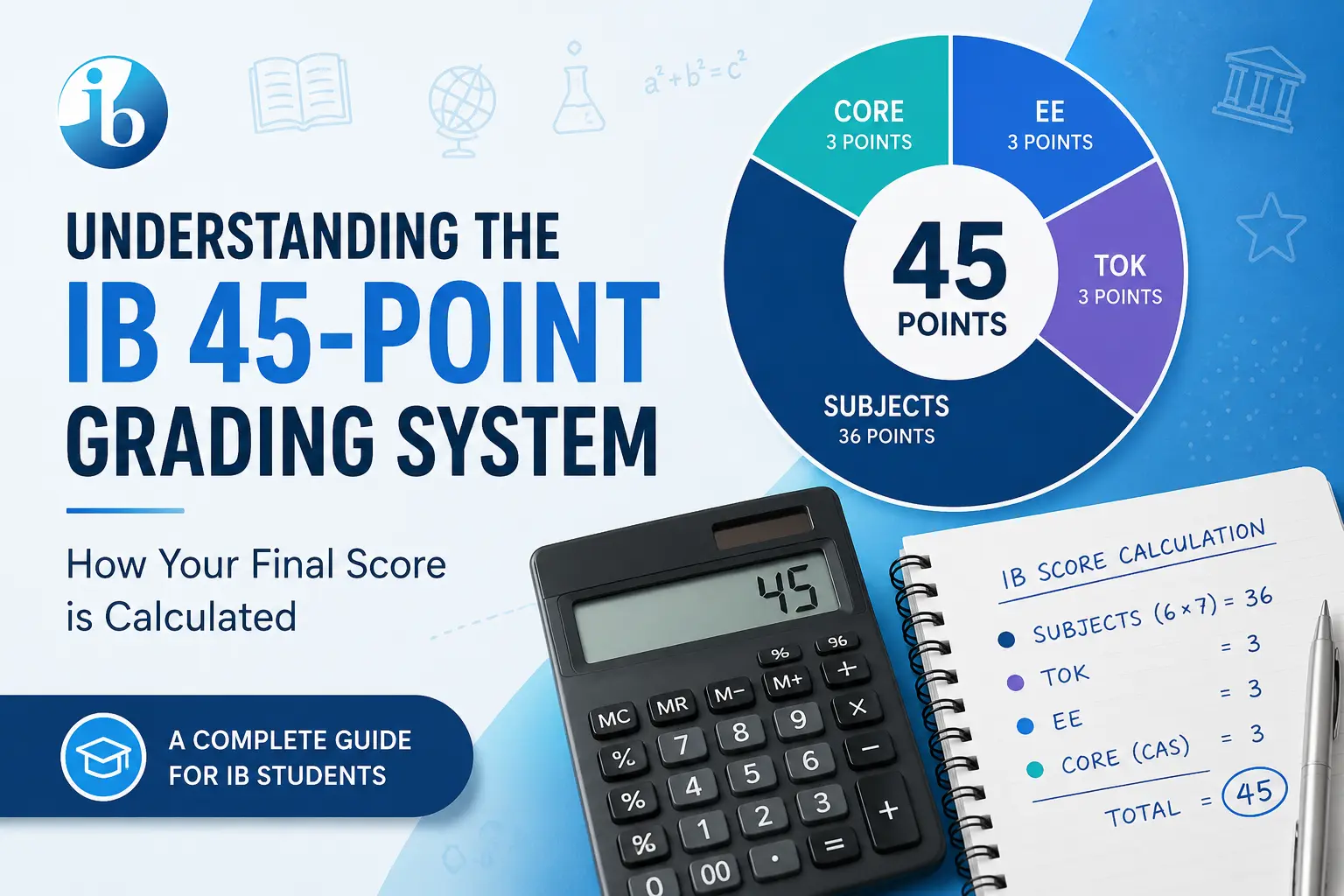
The minimum of 24 points and the maximum IB Diploma score are 45 points. The maximum IB consists of 42 points from six subjects plus up to 3 bonus points from TOK and the Extended Essay.




































0 Comments