






International Baccalaureate (IB) Grading System Explained: How the 45-Point Score is Calculated
The International Baccalaureate 45-point grading system provides students with the complete means to assess themselves before they go to university. This grading system is designed to evaluate both academic understanding and critical thinking.
The International Baccalaureate Diploma Programme (IBDP) is internationally recognised for its academic rigour and holistic approach to learning. The IB grading system is distinct from other high school assessment methods, so it is crucial that students understand how it works.
The IB grading system looks at how marks are evaluated in six subjects and also at the Theory of Knowledge and the Extended Essay.
Understanding this grading system is really helpful for students to know how their International Baccalaureate score is calculated. This helps students make a plan for their studies. It also helps them get into the university they want to go to. The International Baccalaureate 45-point grading system is crucial for students who want to go to university.
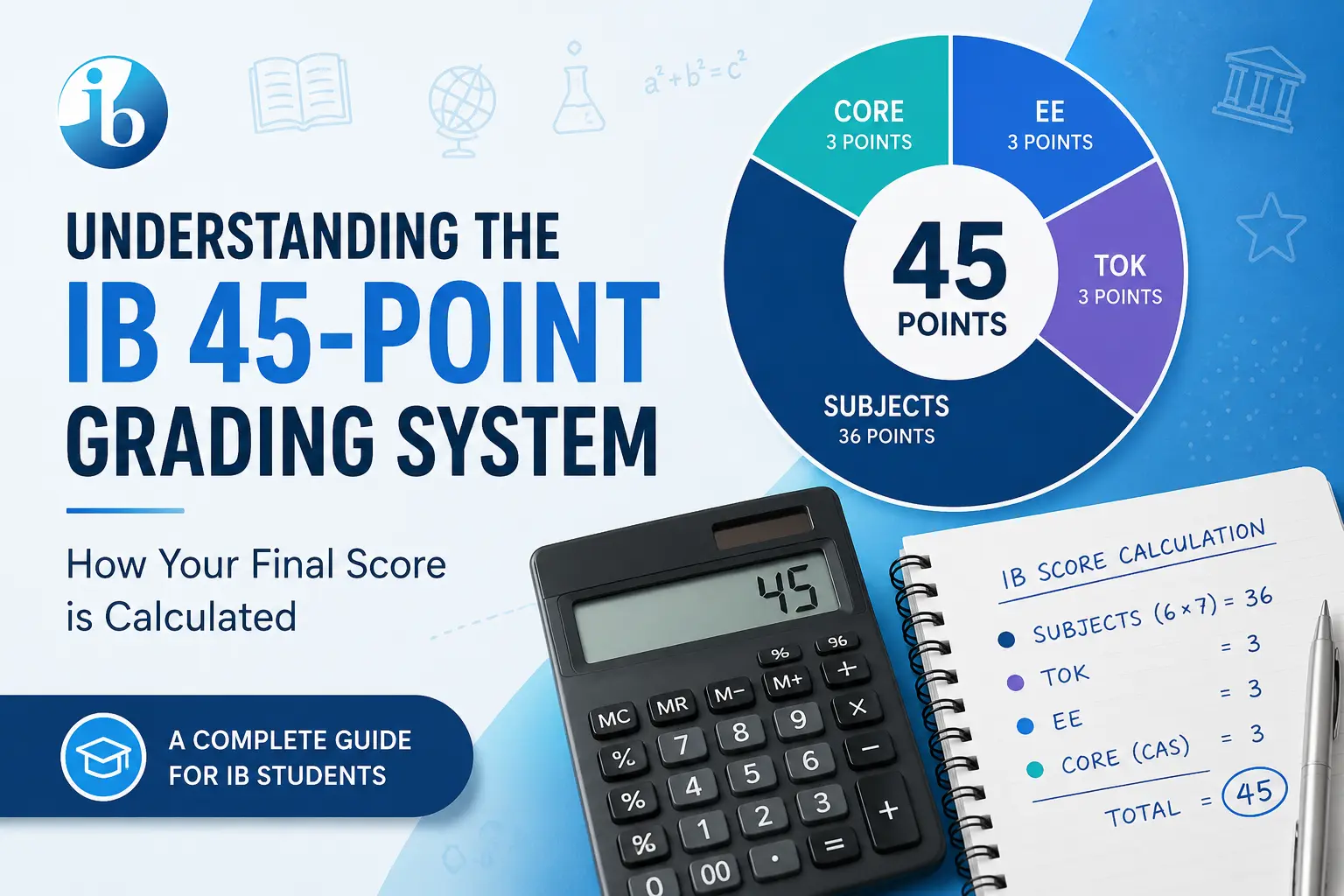
The IB grading system uses a maximum score of 45 points. Students earn up to 42 points from six subjects, each graded from 1 to 7, and up to 3 additional core points from the Theory of Knowledge (TOK) and the Extended Essay (EE). Creativity, Activity, and Service (CAS) is mandatory but does not contribute to the final score.
IB Final Score Formula Six Subject Grades (Maximum 42 Points) Formula at a Glance 42 Subject Points + 3 Core Points (TOK + EE) = 45 Maximum IB Score Example
Final IB Score = 39/45 |
In this article, let us learn in detail about the IB grading system, how each part affects the IB score and what one needs to do to get the IBDP, which is a well-respected award.
Table of Contents
- What is the IB 45-Point in the IB Grading System?
- How are IB Subject Scores Calculated?
- Higher Level (HL) vs Standard Level (SL)
- IB Internal Assessment vs External Exams
- How are Core Points Awarded?
- What are IB Grade Boundaries?
- IB Final Score Calculation
- What is the Passing Score for the IB Diploma?
- Is a 40+ IB Score Good?
- How to Maximise Your IB Score?
- Common Mistakes Students Make
- Can Students Retake IB Exams?
- Conclusion
- FAQs
What is the IB 45-Point in the IB Grading System?
The IB Diploma Programme uses a 45-point grading scale, with 45 being the highest possible score. The IB grading system is divided into two main categories so that students need to understand how their final diploma score is calculated.
The final score is made up of:
- 42 points from six academic subjects
- 3 additional core points from Theory of Knowledge (TOK) and the Extended Essay (EE)
The IB Grading System is based on internal assessments (such as projects and research work) and final external exams. The Creativity, Activity, Service (CAS) component is mandatory for earning the diploma, but it does not contribute points to the final score.
IB Score Breakdown
| Component | Maximum Points |
| Six Subjects | 42 |
| Theory of Knowledge (TOK) + Extended Essay (EE) | 3 |
| Total Maximum Score | 45 |
How are IB Subject Scores Calculated?
Every IBDP student studies six subjects, generally one from each subject group.
These groups include:
Group 1: English Language and Literature HL/SL
Group 2: Language Acquisition
Group 3: Individuals and Societies
Group 4: Sciences
Group 5: Mathematics
Group 6: The Arts (or an additional subject from another group)
Each subject is graded on a scale from 1 to 7.
7 = Excellent performance with a complete understanding of the subject 6 = Very good grasp of the subject with few mistakes 5 = Good performance with a consistent understanding 4 = Satisfactory, meets minimum expectations 3 = Mediocre; shows limited achievement 2 = Poor, needs improvement 1 = Very poor; severe lack of understanding |
Since there are six subjects, the highest possible academic score is:
| 6 subjects × 7 points = 42 points |
The following example illustrates how the six subject scores contribute to the final academic score.
| Subject | Score |
| English A | 6 |
| Spanish B | 6 |
| Economics | 7 |
| Biology | 6 |
| Mathematics AA | 5 |
| Visual Arts | 7 |
| Total Subject Score = | 37/42 |
Higher Level (HL) vs Standard Level (SL)
In IB Diploma programmes, students study three Higher Level (HL) and three Standard Level (SL) subjects, creating a balanced academic programme.
Every IBDP student studies:
- Three Higher Level (HL) subjects
- Three Standard Level (SL) subjects
Although HL subjects involve greater depth and more instructional hours, both HL and SL subjects are graded on the same 1–7 scale.
HL subjects are often more important for university admissions, as many universities specify HL grade requirements for competitive programmes.
The table below compares Higher Level (HL) vs Standard Level (SL) subjects:
| Higher Level (HL) vs Standard Level (SL) | |
| Higher Level (HL) | Standard Level (SL) |
| Covers subjects in greater depth and breadth. | Covers the core concepts of each subject. |
| Requires more teaching hours and a higher workload. | Requires fewer teaching hours than HL. |
| Students typically choose three HL subjects. | Students typically choose three SL subjects. |
| It often carries greater weight for university admissions, especially for competitive programmes. | It contributes to the overall IB Diploma score but is generally given less emphasis in programme-specific admissions. |
| Recommended for subjects related to a student's intended university course or career path. | Suitable for subjects outside the student's primary academic focus. |
Which Is More Important for University Admissions?
Many universities place greater emphasis on Higher Level (HL) subjects, especially for competitive courses such as Medicine, Engineering, Business, and Law. Admission offers often specify minimum HL grades rather than only an overall IB score.
For this reason, students should choose HL subjects that align with their intended university programme and select SL subjects that complement their overall academic profile.
IB Internal Assessment vs External Exams
Internal Assessments evaluate students through coursework, while External Examinations assess their knowledge through final written exams. However, both components contribute to the final subject grades, with the exact weighting depending on the subject.
In this IB grading system, each subject grade combines performance from both Internal Assessments and External Examinations.
The Internal Assessments include:
- Geography fieldwork
- History investigations
- Mathematics explorations
- Oral language assessments
- Science practical investigations
- Business Management commentaries
The Internal Assessments are completed during the course and graded by teachers before being moderated by the IB. The weighting of Internal Assessments varies by subject.
External assessments include:
- Essays
- Case studies
- Final written examinations
- Subject-specific assessment tasks.
External assessments are evaluated by IB examiners, which typically account for the largest percentage of the final grade.
Here is the comparison of HL and SL subjects
| Internal Assessments vs External Examinations | |
| Internal Assessments | External Examinations |
| Conducted and initially assessed by teachers, then moderated by the IB. | Set and assessed externally by the International Baccalaureate (IB). |
| Include coursework such as investigations, projects, oral presentations, portfolios, or practical work, depending on the subject. | Consist of written examinations taken at the end of the programme. |
| Assess research, analytical, practical, and communication skills. | Evaluate students' understanding and application of the syllabus under exam conditions. |
| Contribute a percentage of the final subject grade (weightage varies by subject). | Typically, they make up the majority of the final subject grade, although the weightage varies by subject. |
| They are completed during the two-year Diploma Programme. | These assessments are held during the official May or November examination sessions. |
How are Core Points Awarded?
Beyond the six subjects every IBDP student completes two core academic components. These are
Theory of Knowledge (TOK)
TOK encourages students to explore how knowledge is created, evaluated, and applied across different disciplines.
In TOK students have to perform the following tasks:
- An essay
- An exhibition
The Extended Essay is another core component.
It is a 4,000-word research project on a topic that the student chooses. This core component helps students develop skills for university, such as
- Referencing
- Critical thinking
- Academic writing
- Academic research
- Independent analysis
Here each core academic component (TOK and EE) is graded on a scale from A, where A is the highest grade and E is the lowest.
The grades for both TOK and EE together determine how many core points a student receives.
Here is an example core component Grading System:
| TOK Grade | EE Grade | Core Points |
| A | A | 3 |
| A | B | 3 |
| B | A | 3 |
| B | B | 2 |
| C | B | 1 |
| C | C | 1 |
| D | C | 0 |
| E | Any | Diploma Conditions Apply |
Here, students can earn additional points between 0 and 3.
What are IB Grade Boundaries?
One of the most common questions students ask is, "How many marks do I need to score a 7?"
The answer depends on IB grade boundaries.
Grade boundaries are the minimum marks required to achieve each grade (1–7). They are reviewed after every examination session and may vary slightly each year based on factors such as exam difficulty and overall student performance.
For example, earning 75% in one subject may result in a Grade 7, while another subject may require a different percentage. This variation is because each subject has its own assessment structure and grading criteria.
Instead of focusing only on raw marks, students should aim to perform consistently across:
- Internal Assessments
- Written examinations
- Subject-specific assessment components
Understanding grade boundaries helps students set realistic targets throughout the programme.
IB Final Score Calculation
The final IB grading system includes both coursework and exams.
For example:
| Subject | Score |
| English A | 6 |
| French B | 5 |
| Chemistry | 7 |
| Biology | 6 |
| Mathematics AA | 6 |
| Economics | 6 |
| Total Subject Score = | 6 + 5 + 7 + 6 + 6 + 6 = 36 |
- TOK Grade: B
- Extended Essay Grade: A
- Core Points Awarded: 3
Final IB Score:
- Subject Points: 36
- Core Points: 3
Final Score = 39/45
Subject grades account for the majority of the final diploma score. For each subject, students get a score out of 7. So that means all subjects contribute 42 out of 45 points.
What is the Passing Score for the IB Diploma?
To be awarded the IB Diploma, students generally need to achieve at least 24 points, provided they also meet all diploma award requirements.
These requirements include:
- Successfully completing CAS
- Meeting minimum performance standards in Higher Level and Standard Level subjects
- Avoiding failing conditions specified by the IB
- Completing both TOK and the Extended Essay
Simply achieving 24 points does not automatically guarantee the diploma if other programme requirements are not met.
Is a 40+ IB Score Good?
Yes. A score of 40 or above is considered an excellent achievement. Students who score 45 points are considered among the highest-performing IB students worldwide.
As a general guide:
| 24–29: Diploma awarded (subject to conditions). |
| 30–34: Good universities |
| 35–39: Highly competitive universities. |
| 40–45: Top global universities (subject to programme requirements) |
Scoring 45 points in the IB places students among the top achievers and can significantly strengthen their university applications, especially for competitive programmes.
Universities typically have specific IB score requirements, with many top institutions looking for scores in the high 30s to 40s.
How to Maximise Your IB Score?
Achieving a high IB score requires consistent effort throughout the Diploma Programme rather than relying solely on final examinations. Since the IB assesses students through coursework, projects, and exams, maintaining steady performance across all components is essential.
Here are some practical strategies to improve the final IB score:
1. Choose Higher-Level Subjects Strategically
Select Higher Level (HL) subjects that align with one's strengths, interests, and intended university course. Strong HL grades can significantly strengthen university applications.
2. Stay Consistent Throughout the Programme
Avoid leaving revision until the final examination period. Review class material regularly, complete assignments on time, and monitor one's progress in each subject.
3. Take Internal Assessments Seriously
Internal Assessments contribute directly to the final subject grades. Start the research early, seek feedback from teachers, and submit polished work to maximise the marks.
4. Prepare Thoroughly for TOK and the Extended Essay
Although TOK and the Extended Essay contribute only three points, these bonus points can make a significant difference to the final diploma score and university admissions.
5. Understand the Assessment Criteria
Each IB subject has detailed marking criteria. Familiarising oneself with these rubrics will help students understand what examiners expect and improve their performance.
6. Practise with Past Papers
Past examination papers help students to:
- Become familiar with question formats
- Improve time management
- Identify weak topics
- Build confidence before exams
7. Seek Guidance When Needed
If students struggle with a subject, ask teachers, tutors, or academic mentors for support early rather than waiting until examinations approach.
Common Mistakes Students Make
Many students lose valuable marks because of avoidable mistakes. Being aware of these pitfalls can help students perform more effectively.
Common mistakes include:
- Ignoring Internal Assessments until the last minute
- Choosing Higher Level subjects without considering workload
- Underestimating the importance of TOK and the Extended Essay
- Focusing only on final examinations
- Neglecting time management
- Missing CAS requirements
- Not reviewing examiner reports and marking criteria
Planning ahead and maintaining a balanced study schedule can help avoid these challenges.
Can Students Retake IB Exams?
Yes. Students who are dissatisfied with their results can retake IB examinations during a future examination session.
Depending on individual circumstances, students may:
- Retake one or more subjects
- Improve individual subject grades
- Increase their overall diploma score
Retaking examinations may help students meet university admission requirements or improve scholarship opportunities.
Students should consult their IB school regarding registration deadlines, examination sessions, and eligibility requirements.
Conclusion
The IB 45-Point Grading System is designed to provide a comprehensive assessment of students’ knowledge, skills, and personal growth.
By evaluating the scores through both subject grades and core components like ToK, EE, and CAS, the IB Grading System ensures a holistic approach that values academic and personal development alike.
Thus, by understanding the IB Grading System, students can help themselves achieve their best outcome.
Are you planning to study the IB Diploma Programme? Looking for the best IB schools in Bangalore?
Knowledgeum Academy is one of the best IB schools in Bangalore, integrating its extensive expertise in educational design with organised programme delivery to prepare learners for academic, professional, and societal impact.
For further assistance and next steps, connect with our admission experts. Our academic advisors are also here to help you choose the right IB subjects, understand university entry requirements, and build a strong application for leading universities worldwide. Contact us today for personalised guidance.
For more details about the Career Advisory and Guidance, visit our website.
Frequently Asked Questions (FAQs)
In the IB Diploma Programme, 45 points are considered the highest possible score, including:
- 42 points from six academic subjects.
- 3 additional core points from Theory of Knowledge (TOK) and the Extended Essay (EE).
Frequently Asked Questions (FAQs)
The Creativity, Activity, and Service (CAS) is one of the three core components of the IB Diploma Programme.
No. CAS is assessed on successful completion rather than a numerical grade.
Those students who fail to complete the CAS requirements are not awarded the IB Diploma, even if they achieve the required academic points.
Yes. A score of 42 out of 45 is a good IB score and is considered highly competitive for admission to top universities worldwide.
Yes. A score of 35 is considered a strong IB result. More selective institutions may require higher scores for competitive programmes.
Most universities consider 35+ a strong score, while 40+ is highly competitive.
Scoring the maximum 45 points is extremely challenging.
If you fail or receive an E grade in Theory of Knowledge (TOK), you may not be awarded the IB Diploma programme.
Yes. Students can retake IB exams in a future examination session to improve their subject grades.
TOK and the Extended Essay contribute up to 3 core points.
No. The Creativity, Activity, Service (CAS) component does not contribute points to the final IB Diploma score.
Yes. The Creativity, Activity, Service (CAS) component is mandatory for earning the International Baccalaureate Diploma Programme (IBDP).
Higher Level (HL) subjects are generally more important for university admissions. This is primarily because many universities specify HL grade requirements for competitive programmes. However, both HL and Standard Level (SL) subjects contribute to the overall diploma score.
The IB Diploma Programme uses a 45-point grading scale.
In the IB Diploma Programme 45 points are considered the highest possible score, among which
- 42 points are from six academic subjects
- 3 additional core points are from Theory of Knowledge (TOK) and the Extended Essay (EE)
Yes. Beyond the six academic subjects, these two core academic components, Theory of Knowledge (TOK) and the Extended Essay (EE), add up to three additional core points. The points are awarded from A (highest) to E (lowest).
Receiving an E may prevent a student from being awarded the IB Diploma, depending on the overall diploma award conditions.



































0 Comments