





How IBDP Graduates Succeed in Higher Education
IBDP graduates succeed in higher education because the IB Diploma Programme nurtures critical thinking through inquiry-based learning, research through DP core elements like the Extended Essay, and readiness through time management, communication skills, and global exposure. The IB curriculum is recognised in over 150 countries, reflecting the global adaptability the programme imparts.
In essence, the IB Diploma Programme fosters learners who can deal with complicated ideas and handle demanding coursework, ensuring readiness for university-level education. This blog explains how the IBDP drives learners to perform better when compared to traditional boards:
Table of Contents
- Understanding the Advantages of IB in Education
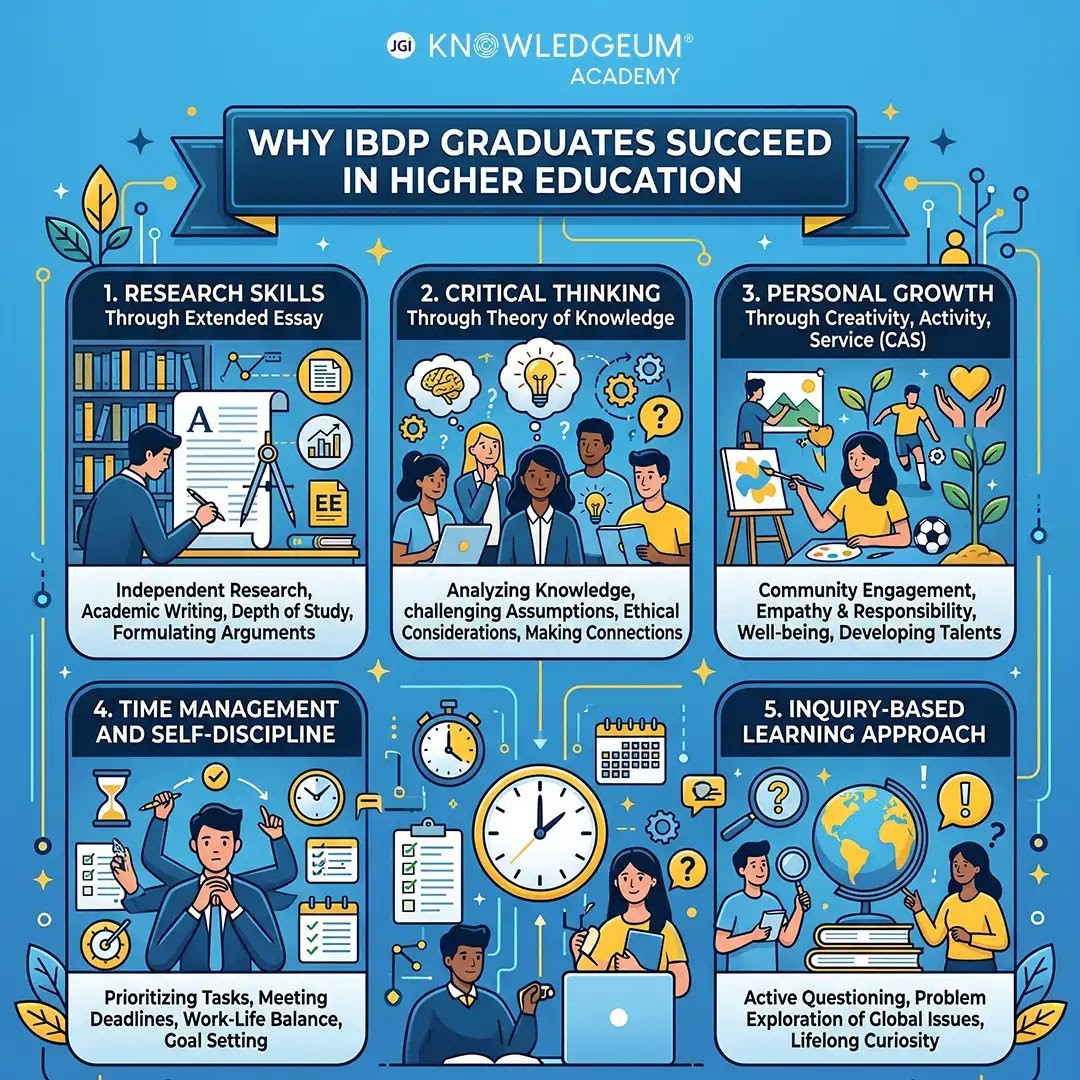
- Research Skills Through Extended Essay
- Critical Thinking Through Theory of Knowledge
- Personal Growth Through Creativity, Activity, Service
- Time Management and Self-Discipline
- IBDP vs Traditional Curricula for University Readiness
- Global Recognition for University Admissions
- Challenges Faced by IBDP Graduates
- Conclusion
- FAQs
Understanding the Advantages of IB in Education
The International Baccalaureate Diploma Programme is known for its academic rigour. The IBDP curriculum has six subject groups. The learners study three or four subjects at the higher level and the remaining subjects at the standard level.
However, there is more to IBDP than subject groups. The learning environment encourages learners to build arguments, evaluate evidence, and analyse perspectives instead of rote memorisation. The IB assessment is also recognised for contributing to its challenging structure. It is divided into two parts where written examinations are marked by professionally trained examiners and the internal assessments are evaluated by internal IB-trained educators.
Research Skills Through Extended Essay
The Extended Essay (EE) is one of the DP core elements in IBDP. It is a 4000-word individual research paper that involves exploring an area of interest by conducting a comprehensive study on the chosen topic. The process entails posing effective questions, finding credible sources for the essay, and presenting solid arguments.
These skills become highly valuable when writing research papers in college or preparing for dissertations in the future. The skills acquired during the EE process can be directly applied to university assignments.
Critical Thinking Through Theory of Knowledge
The Theory of Knowledge (TOK) encourages learners to reflect on the nature of knowledge. Instead of concentrating on information and facts, TOK asks learners to question how we know things. The TOK assignment asks learners to investigate different concepts to review their ways of acquiring knowledge. This process takes them beyond simple textbook knowledge to analyse complex questions.
Such a skill is necessary when studying at a university, as it helps learners to analyse different texts, ask critical questions, and establish claims. It is not only about writing papers or attending seminars, as the ability to think deeply and rationally becomes beneficial for personal as well as professional life.
Personal Growth Through Creativity, Activity, Service
The Creativity, Activity, Service (CAS) element in the DP core takes education in the IBDP programme beyond classroom learning. Throughout the two years of the programme, learners are involved in various activities, including artistry, sports, or community service. This approach helps them cultivate important skills like teamwork, leadership qualities, and resilience.
Through CAS, learners take a leap out of their comfort zone and learn to recognise and address the challenges in society. This type of ethical learning and personality development holds a lot of importance during university education, especially when success is not measured only in terms of good academic performance.
Time Management and Self-Discipline
Balancing six subjects, internal evaluations, CAS activities, and other core components requires time management skills. Learners need to prioritise and manage the workload effectively in order to achieve the academic goals.
These qualities are considered helpful at the university level as learners navigate higher education pressures and stress with minimal support and guidance.
- Break tasks into weekly targets
- Set deadlines earlier than the official date
- Keep a simple revision routine
- Use reflections (CAS/TOK) to improve focus
IBDP vs Traditional Curricula for University Readiness
| Aspect | IBDP | Traditional Curricula |
| Learning Approach | Inquiry-based, analytical | Content-focused, exam-driven |
| Research Exposure | Extensive (EE, IA) | Limited |
| Skill Development | Critical thinking, time management | Memorisation, test performance |
| University Preparation | Strong alignment | Moderate alignment |
Global Recognition for University Admissions
IBDP is recognised by top universities around the world, as the curriculum shapes learners into global citizens over the course of two years. IBDP learners are often well prepared for university-level studies. Additionally, many universities provide advanced standing or credit for learners who take certain subjects under the programme.
The 2021 research* based on the World Values Survey showed that IBDP learners from Australia, Germany, Japan, Mexico, Spain, and the United States have higher levels of global-mindedness than their peers from their curricula.
*Summary developed by the IB Research department based on a report by Fernanda Gándara, Aimee Reeves, and Drew Schmenner.
Challenges Faced by IBDP Graduates
The study in the United Kingdom* highlighted that IB diploma learners were three times more likely to enrol at top 20 higher education institutions than A-level learners. However, there are some difficulties that IBDP learners might encounter in university. The first one can be adjusting to less disciplined surroundings, where there are fewer deadlines but higher expectations.
Another problem is that the initial academic pressure at universities may feel less intense than the IBDP programme. Nevertheless, all these challenges usually do not last for long, and learners cope with them quickly.
*Key findings from research on the impact of the Diploma Programme, conducted by the International Baccalaureate (IB) Research department.
Conclusion
The IBDP goes beyond a traditional curriculum, as it prepares learners for university life and beyond. The skills that learners develop through this programme not only enable them to succeed in their studies but also prepare them well for professional life.
It is recommended to enrol at one of the top IB schools in Bangalore, like Knowledgeum Academy, where learners can achieve their full potential. Want to know more? Get in touch with us today to schedule your visit.
Have you experienced the benefits of IB programmes? If yes, please share your experience with us in the comments section.

















0 Comments