






IBDP Group 3: Individuals and Societies – Options and Benefits
IBDP Group 3: Individuals and Societies includes humanities and social science subjects such as Economics, History, Psychology, Geography, Business Management, and Global Politics. It helps learners build critical thinking, research, and real-world analysis—ideal for pathways like law, business, international relations, and social sciences.
IBDP Group 3 connects academic learning with real-world social, political, economic, and cultural issues.
Group 3 subjects encourage learners to explore beyond textbooks and engage with real-world issues. The subjects encompass topics such as the following:
- Societies
- Economics
- Global issues
- Political systems
- Human behaviour
These subjects focus primarily on critical thinking and the evaluation of multiple perspectives.
Whether learners are interested in business, law, international relations, or social sciences, this group offers a strong foundation that is both practical and intellectually engaging. These skills are applicable in both academic and everyday contexts.
More importantly, IBDP Group 3 equips learners with abilities that support academic and real-world problem-solving, helping them become more informed and thoughtful global citizens.
Let’s explore IBDP Group 3: Individuals and Societies in more detail.
| Quick Summary: IBDP Group 3: Individuals and Societies |
| Focuses on: Human Behaviour, Societies, and Global Systems |
| Key Skills: Develops critical thinking, research, and analytical skills |
| Available at Higher Level (HL) and Standard Level (SL) |
| Prepares learners for careers in law, business, policy, and social sciences |
| Popular subjects in IBDP Group 3:HistoryEconomicsGeographyPsychology Global PoliticsBusiness Management |
Table of Contents
- What is IBDP?
- What is IBDP Group 3?
- Subjects Offered in IBDP Group 3
- Skills Developed in IBDP Group 3
- How to Choose an IB Group 3 Subject Based on Career Goals
- Higher Level (HL) vs Standard Level (SL): Individuals and Societies
- Conclusion
- FAQs
What is IBDP?
The International Baccalaureate Diploma Programme (IBDP) is an intensive and internationally recognised academic qualification that provides learners with a well-rounded education. This programme is designed to challenge learners academically and to encourage personal growth.
One of the unique aspects of the IBDP is its core, which consists of three key components. While some interdisciplinary skills may not be directly covered within a learner’s chosen subjects, they still play an important role in their overall education.
The IB Diploma Programme is organised into six subject groups, each focusing on a different area of learning:
| Group 1: Studies in Language and Literature |
| Group 2: Language Acquisition |
| Group 3: Individuals and Societies |
| Group 4: Sciences |
| Group 5: Mathematics |
| Group 6: The Arts |
%20vs%20Standard%20Level%20(SL).webp)
What is IBDP Group 3?
In the International Baccalaureate Diploma Programme (IBDP), Group 3: Individuals and Societies subjects play an important role in developing analytical and research skills.
IBDP Group 3: Individuals and Societies focuses on the study of humanities and social sciences. It explores human behaviour, societies, and the world we live in.
Choosing Group 3 subjects helps learners develop critical thinking, research, and analytical skills and meet university prerequisites.
Each IBDP subject group is designed to help learners gain the ability to:
- Identify key issues
- Interpret different perspectives
- Communicate evidence-based conclusions
- Develop the ability to identify and critically analyse information
- Evaluate various theories, concepts, and arguments effectively
The article discusses Group 3 without clearly explaining how the IBDP subject-group structure works.
Subjects Offered in IBDP Group 3
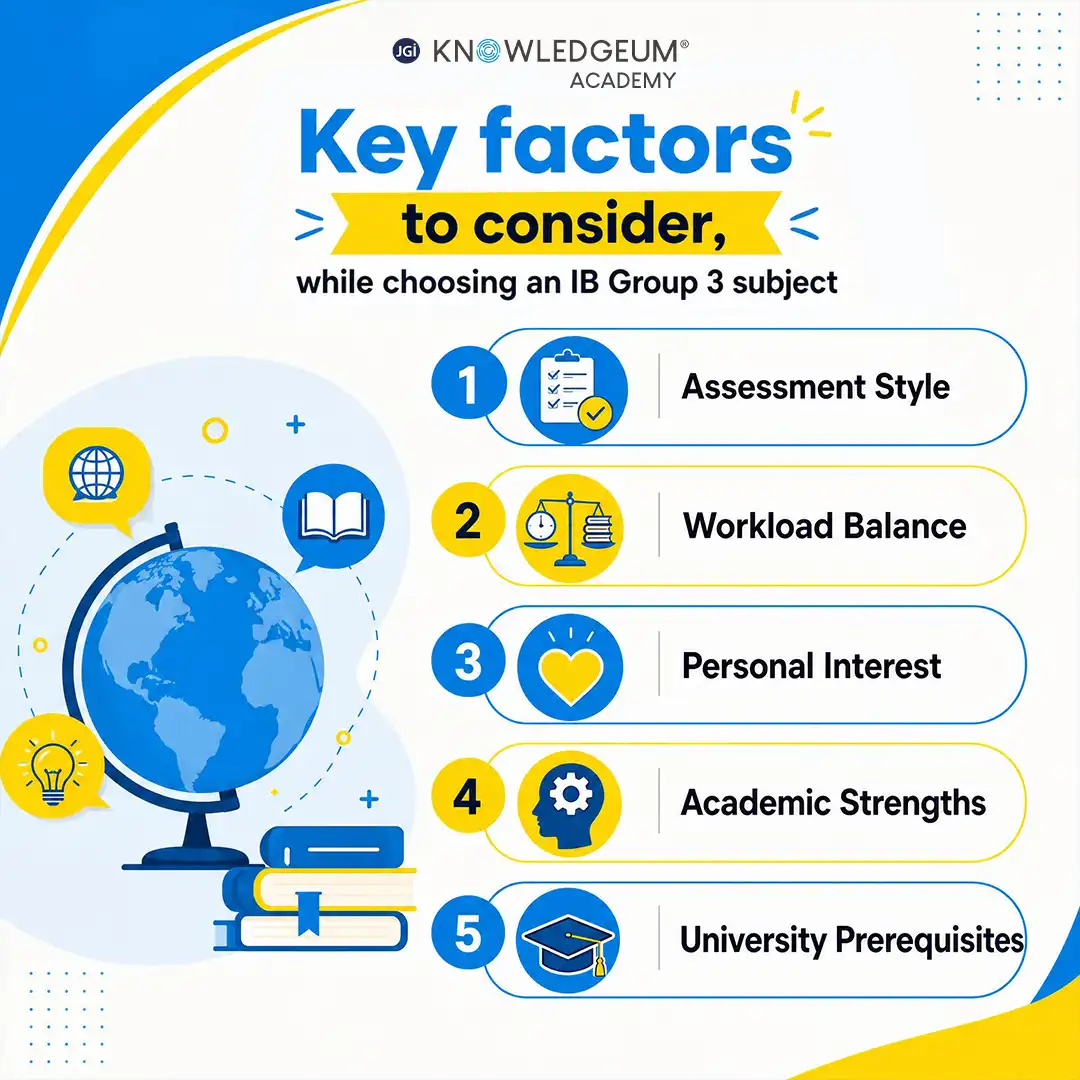
This IB Diploma Programme subject group takes a global perspective. There are six academic groups of subjects.
Learners typically choose one subject from each group to create a balanced academic programme.
The subjects of IBDP Group 3 are considered individuals and societies. This group includes important subjects such as economics, business management, psychology, geography, and history.
Learners are required to choose one subject from each of the six academic areas, including individuals and societies. Learners may replace a Group 6 subject with an additional IBDP subject groups from Groups 1–5
There are several distinct subjects within Group 3: Individuals and Societies
History
- This IBDP subject group is ideal for learners who enjoy analysing historical and contemporary events, working with evidence and sources, and composing well-reasoned written arguments.
- Typical assessment styles include the following:
- Predominantly essay-based
- Emphasis on source analysis and evaluation
- Requires structured, evidence-based arguments
- Often conducted under time-bound examination conditions
Economics
- This IBDP subject group, Economics, is ideal for learners interested in how markets, governments and individuals make decisions about resources.
- Typical assessment styles include the following:
- Data-heavy questions
- Short-answer questions using key concepts
- Extended responses (essay-style explanations and evaluations)
- Strong emphasis on graphs, evaluation, critical thinking and Application of economic theory to real-world scenarios
Psychology
- This IBDP subject group is ideal for learners who want to learn and understand behaviour and are curious about mental processes, mental health, and research methods.
- Typical assessment styles include the following:
- Essay-heavy responses
- Focus on theories' and studies' evaluation
- Structured essays using research evidence
- Includes experimental/research components (Internal Assessment)
Geography
- This IBDP subject group is ideal for learners who are interested in understanding how the world works through the interaction of people, places, and environments, including global challenges such as climate change and urbanisation.
- Typical assessment styles include the following:
- Case study-based questions
- Includes fieldwork (Internal Assessment)
- Data interpretation (maps, graphs, charts)
- Structured responses applying real-world examples
Business Management
- This IBDP subject group is ideal for learners who are interested in entrepreneurship, leadership, and decision-making in real-world organisations.
- Typical assessment styles include the following:
- Case study-based questions
- Emphasis on real business scenarios
- Application of business tools and concepts
- Structured responses with decision-making and evaluation
Philosophy
- This IBDP subject group is ideal for learners who enjoy debating, questioning assumptions, and exploring abstract ideas such as ethics, knowledge, and reality.
- Typical assessment styles include the following:
- Essay-heavy
- Focus on argument construction and critical evaluation
- Structured philosophical writing using logical reasoning
Social and Cultural Anthropology
- This IBDP subject group is ideal for learners who are interested in cultures, societies, research, sociology, and development studies, especially those considering sociology, development studies, or global studies.
- Typical assessment styles include the following:
- Research-based and essay-heavy
- Evaluation of cultural perspectives and contexts
- Analysis of case studies and ethnographic research
Overall, studying any one of these IBDP subject groups develops a critical understanding of:
- Human experience and behaviour
- The history of social and cultural institutions.
- The varieties of physical, economic and social environments that people inhabit
Skills Developed in IBDP Group 3
Subjects in IBDP Group 3 emphasise essay writing, research, and data analysis. Learners improve the ability to build structured arguments, interpret information, and evaluate evidence.
Learners draw on evidence and historical analysis to support their research.
Based on evidence and historical analysis, learners rely on evidence and analysis to conduct research, build and engage in argumentation, interpret data, and develop skills in data analysis to support their insights, while also focusing on human behaviour, social systems, and research skills.
Listed below are some of the key skills developed in IBDP Group 3: Individuals and Societies:
| Subject | Key Skills Developed | Important for |
| History | Essay writing,Critical evaluation | Law, AcademiaHumanities & Civil Services |
| Economics | Logical reasoning, Quantitative analysis | Finance, Business & Data-driven careers |
| Psychology | Research methods,Data interpretation | Research, Healthcare &Human Behaviour |
| Philosophy | Ethical analysis,Critical thinking,Logical reasoning | Law & EthicsAcademia &Critical Thinking fields |
| Geography | Spatial analysis,Real-world problem-solving | Environment, Sustainability & Urban Planning |
| Business Management | Decision-making,Strategic thinking | Entrepreneurship,Management careers |
| Social and Cultural Anthropology | Research,Observation,Cross-cultural analysis | Research,Sociology,Development Studies |
How to Choose an IB Group 3 Subject Based on Career Goals
Choosing the right Group 3 (Individuals and Societies) subject in the IBDP is important because it should align with a learner’s interests, strengths, and future academic goals.
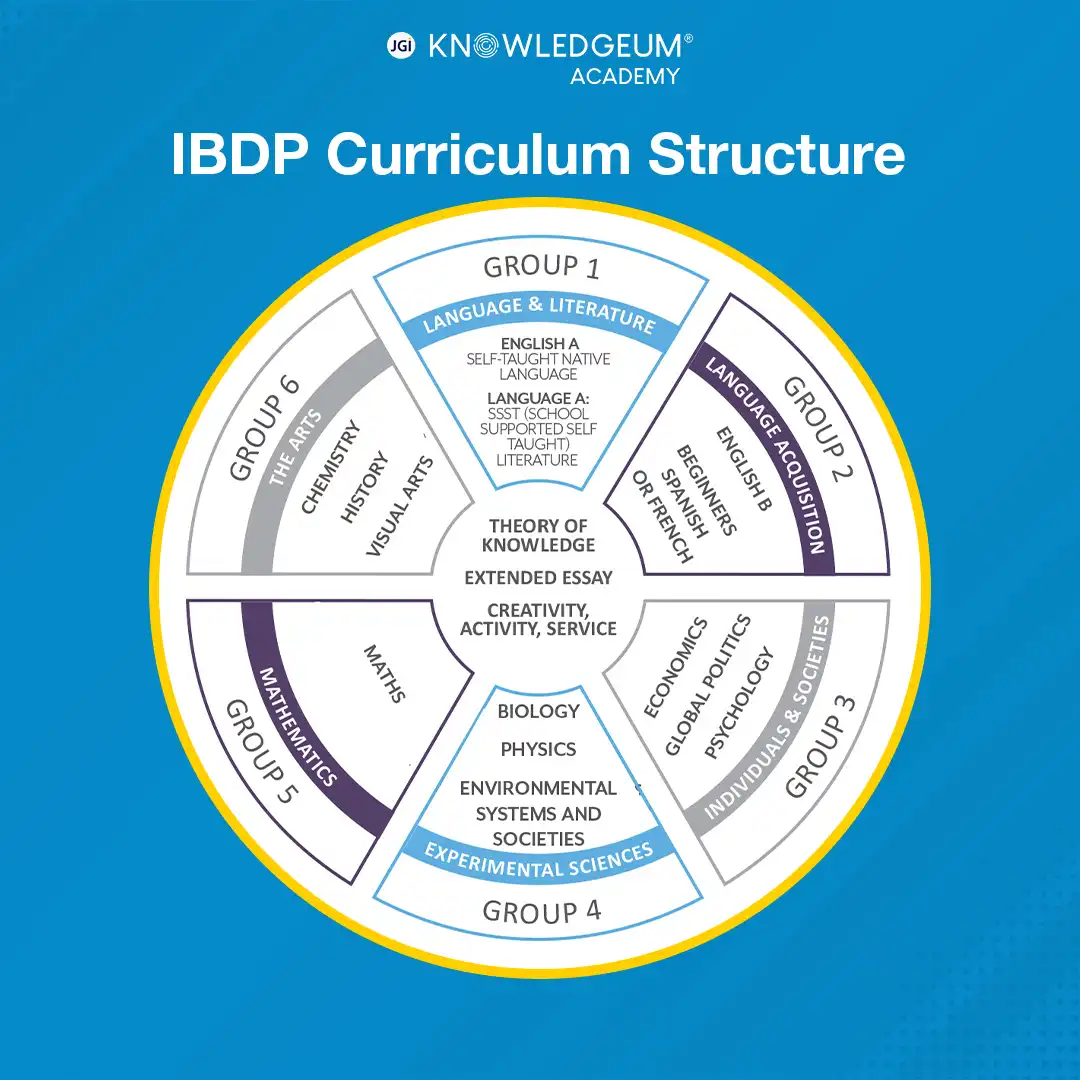
Here are the key factors to consider:
Personal Interest
Learners should always choose a subject that feels engaging and enjoyable. Being interested in a subject often helps maintain motivation and improves overall performance throughout the programme.
Academic Strengths
Select a subject based on individual strengths and learning preferences.
- Those who enjoy writing and critical analysis may find History a good fit.
- Those who are strong in analytical and numerical skills can consider Economics.
Assessment Style
Different subjects have different evaluation methods. Thus, learners must choose based on their preferences:
- Prefer essay-based answers and arguments: History or Psychology.
- Prefer data interpretation and analysis in either Economics or Geography.
University Prerequisites
Before selecting subjects, learners should always review the entry requirements for their intended university courses. Before selecting subjects, learners should always review the entry requirements for their intended university courses. Choosing relevant subjects early can strengthen university applications, especially for fields such as Economics, Business, Law, and Social Sciences.
Workload Balance
It is important for learners to consider the workload and balance it with other chosen subjects.
For instance:
- History and Psychology are content-heavy subjects.
- Geography and Business Management need moderate workloads.
Overall, learners should choose an IBDP Group 3 subject based on career goals, interests, and strengths.
Overall, while selecting Group 3 subjects, learners should reflect the learner's interests, academic strengths, preferred assessment style, and long-term career goals.
Higher Level (HL) vs Standard Level (SL): Individuals and Societies
| Subject | Career Goals | Interests | Strengths Developed |
| History | LawAcademiaHumanitiesCivil Services | Interest in past events, societies, and global developments | Builds strong critical thinking, essay writing, and argumentation skills |
| Economics | FinanceBusinessData-driven careers | Interest in markets, finance, and real-world economic issues | Develops analytical, numerical, and problem-solving skills |
| Psychology | ResearchHealthcareHuman Behaviour | Curiosity about how people think and behave | Enhances research, analysis, and understanding of human behaviour |
| Philosophy | LawEthicsAcademiaCritical Thinking fields | Interest in ethics, logic, and abstract thinking | Strengthens reasoning, debate, and analytical thinking skills |
| Geography | EnvironmentSustainabilityUrban Planning | Interest in global issues, environment, and spatial patterns | Develops data interpretation and real-world problem-solving skills |
| Business Management | EntrepreneurshipManagement careers | Interest in business operations and strategy | Builds decision-making, leadership, and practical business skills |
| Social and Cultural Anthropology | ResearchSociologyDevelopment Studies | Interest in human societies and cultures | Enhances research, observation, and cross-cultural understanding skills |
Conclusion
The IBDP Group 3: Individuals and Societies offers a structured academic pathway. The curriculum is well organised and prepares learners for higher education and future academic pathways.
In addition, each subject fosters the learners' capacity to analyse and assess theories, concepts and arguments relating to the nature and activities of individuals and societies. These subjects connect academic learning with real-world application.
Learners study six subjects (typically three HL and three SL) along with the DP core, with assessments graded by IB examiners.
For further information about the IBDP curriculum and subject choices, visit our website at Knowledgeum Academy or consult our school’s academic advisors.
Which subject within Group 3 interests you the most, and why?
Share your thoughts in the comments below.
Frequently Asked Questions (FAQs)
- Extended Essay (EE)
- Theory of Knowledge (TOK)
- Creativity, Activity, Service (CAS)
- Societies
- Global systems
- Human behaviour
- Contemporary issues
- Analytical thinking
- Critical evaluation
- Research abilities
- An understanding of social and global issues
- Internationally recognised qualification
- Strong preparation for higher education
- Broad and balanced academic curriculum
- Development of research and critical-thinking skills
- Focus on independent learning and global awareness
- History
- Economics
- Geography
- Psychology
- Business Management
- Group 1: Studies in Language and Literature
- Group 2: Language Acquisition
- Group 3: Individuals and Societies
- Group 4: Sciences
- Group 5: Mathematics
- Group 6: The Arts
- Arts
- Science
- Language
- Mathematics
- Social Studies
- Physical Education
- Personal, Social, and Emotional Education


































0 Comments