





Exploring the Environmental Systems and Societies (ESS) Course in the IB Diploma Programme
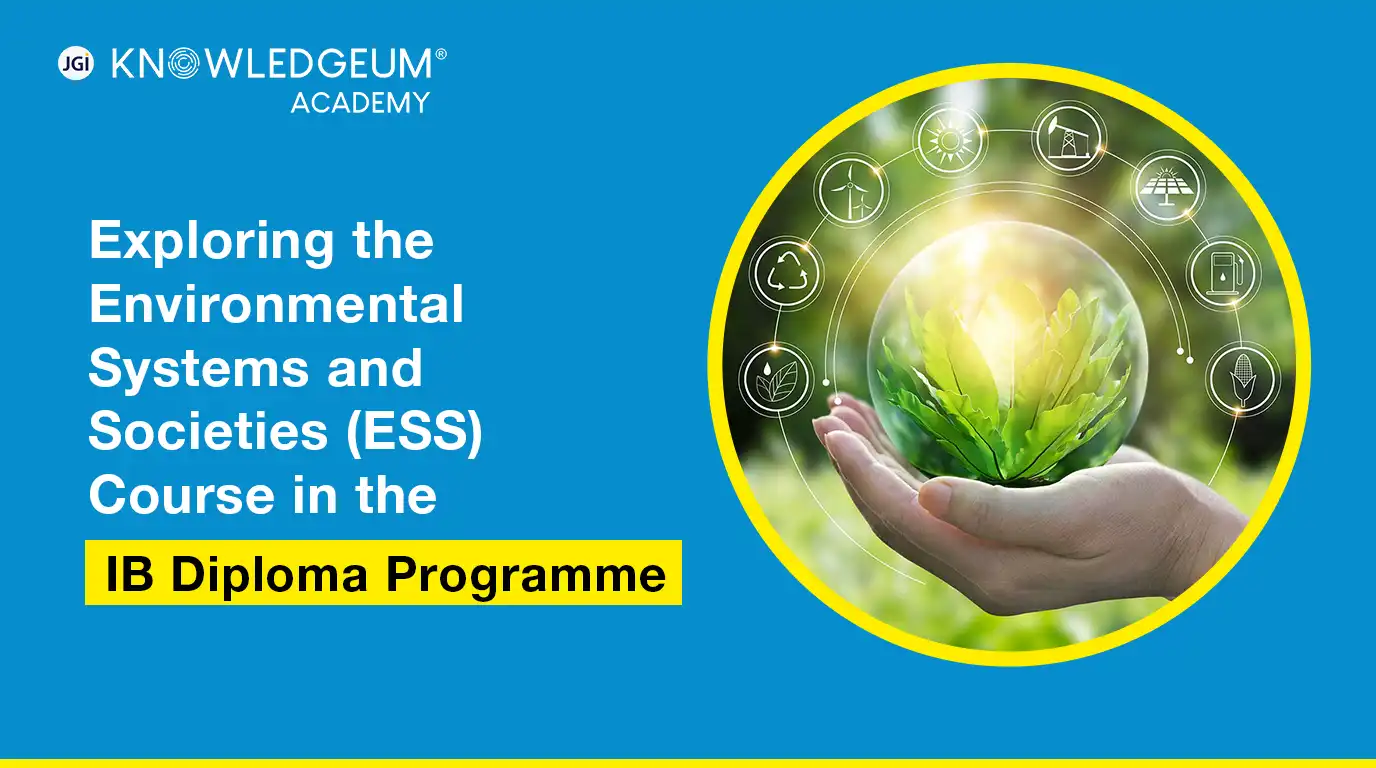
One of the most interesting things about the IB Diploma Programme is that ESS combines science and humanities. This interdisciplinary subject is taught to both Group 3 and Group 4. In other words, it meets both the Sciences (Group 4) requirement and the Individuals and Societies requirement. ESS in IBDP looks at environmental problems from a science perspective while also taking into account social, economic, and moral points of view. This blend of science and humanities offers you a comprehensive view of real-world environmental challenges.
If you are an IB learner who cares about the world and wants to learn how humans and nature interact, Environmental Systems and Societies (ESS) may be a perfect fit. Here is everything you need to know about the Environmental Systems and Societies (ESS) Course in the IB Diploma Programme:
Table of Contents
- Why Environmental Systems and Societies (ESS) Matters in the IB Diploma Programme
- Environmental Systems and Societies IB Syllabus
- ESS at Standard Level: Curriculum, Hours & Skills
- ESS at Higher Level: New 2026 Syllabus Explained
- ESS SL vs HL Comparison
- ESS Assessment Structure in the IB Diploma Programme
- Career and University Pathways After Studying ESS in IB
- Conclusion
- FAQs
Why Environmental Systems and Societies (ESS) Matters in the IB Diploma Programme
Environmental challenges like pollution, climate change, and sustainability are no longer just concepts; they have real effects on our daily lives. The focus is also on the extinction of species due to reasons like habitat loss or overexploitation. You can learn about these issues, their environmental impact, and how you can act to make a difference.
The multidisciplinary nature of ESS in the IBDP draws concepts from Politics, Biology, Geography, Economics, and even Environmental Science. This curriculum helps you see how different subjects are connected, rather than focusing on singular facts. When you study climate change, you are introduced to atmospheric science. You are also expected to examine human activities and evaluate economic and political responses. It teaches you to look at the same problem through different lenses to get the whole picture.
Environmental Systems and Societies IB Syllabus
Even though ESS was part of the IB subject groups earlier, it underwent a significant update in 2024, with the first assessment scheduled for May 2026. The ESS HL is also introduced for the first time. It focuses on three concepts that tie together the ESS curriculum: perspectives, systems, and sustainability. Here are the broad content areas that ESS covers:
- Foundations of environmental systems
- Ecosystems and ecology
- Biodiversity and conservation
- Pollution and waste management
- Climate change and energy resources
ESS at Standard Level: Curriculum, Hours & Skills
If you opt for ESS at Standard Level, the syllabus includes topics such as ecology, biodiversity, water, land, weather and climate change, natural resources, and human population and urban systems. The SL curriculum covers about 150 teaching hours and focuses on giving you a broad understanding of environmental systems, sustainability, and how people interact with natural environments. You also learn how to think critically, do research, and solve problems by studying in class as well as doing real work. It also includes an Individual investigation (internal assessment).
ESS at Higher Level: New 2026 Syllabus Explained
Higher Level (HL) subjects in the IB Diploma Programme go into more detail, are more academically demanding, and are taught for 240 hours. The syllabus for ESS HL covers the same topics as ESS SL, plus topics with an HL-specific lens, including environmental law, environmental ethics, and environmental and ecological economics. Taking ESS HL is ideal if you want to explore environmental science, policymaking, or a related field.
ESS SL vs HL Comparison
| Feature | ESS SL | ESS HL |
| Teaching Hours | 150 | 240 |
| Depth | Foundational | Advanced |
| Best For | Broad learners | Policy- & science-focused learners |
ESS Assessment Structure in the IB Diploma Programme
External Examination Papers
The ESS assessment has two external papers. The first paper will include various data points related to a case study, and the questions will require you to analyse and evaluate that data. The second paper has short-answer, data-based
questions as well as structured essay questions.
Practical and Fieldwork in ESS in IBDP
One of the best parts of ESS is the fieldwork. You gather information, observe environments, and analyse the real environmental problems affecting the larger picture. This takes learning beyond classrooms, staying true to the IB approach.
IB ESS Internal Assessment
The Internal Assessment (IA) is an individual project that carries significant weightage in the final grade. It is a lot like a mini-research project where you pick an environmental problem, collect data to support your argument, and evaluate results through data interpretation. You are expected to present a written report in a maximum of 3,000 words.
Many learners find that ESS has a more balanced workload than heavy lab-based sciences, but the level of difficulty does not change. ESS is not an easy choice, as it needs good writing skills, critical thinking, and the ability to find connections between different subjects. Universities know that ESS is a difficult IB course, especially for programmes that focus on the environment or social sciences.
Career and University Pathways After Studying ESS in IB
ESS helps you build a strong foundation for degrees in geography, urban planning, environmental policy, sustainability studies, and environmental science. It opens doors to careers in environmental consulting, conservation, renewable energy, climate study, NGOs, and corporate sustainability.
Conclusion
In the IB Diploma Programme, Environmental Systems and Societies empowers you to understand complex environmental challenges and the tools you need to properly solve them.
Want to know more? Get in touch with Knowledgeum Academy, where IB-trained educators guide you to pick the best subjects that align with your future goals.
Thinking about the Environmental Systems and Societies (ESS) Course in the IB Diploma Programme? What career are you aiming for?



0 Comments