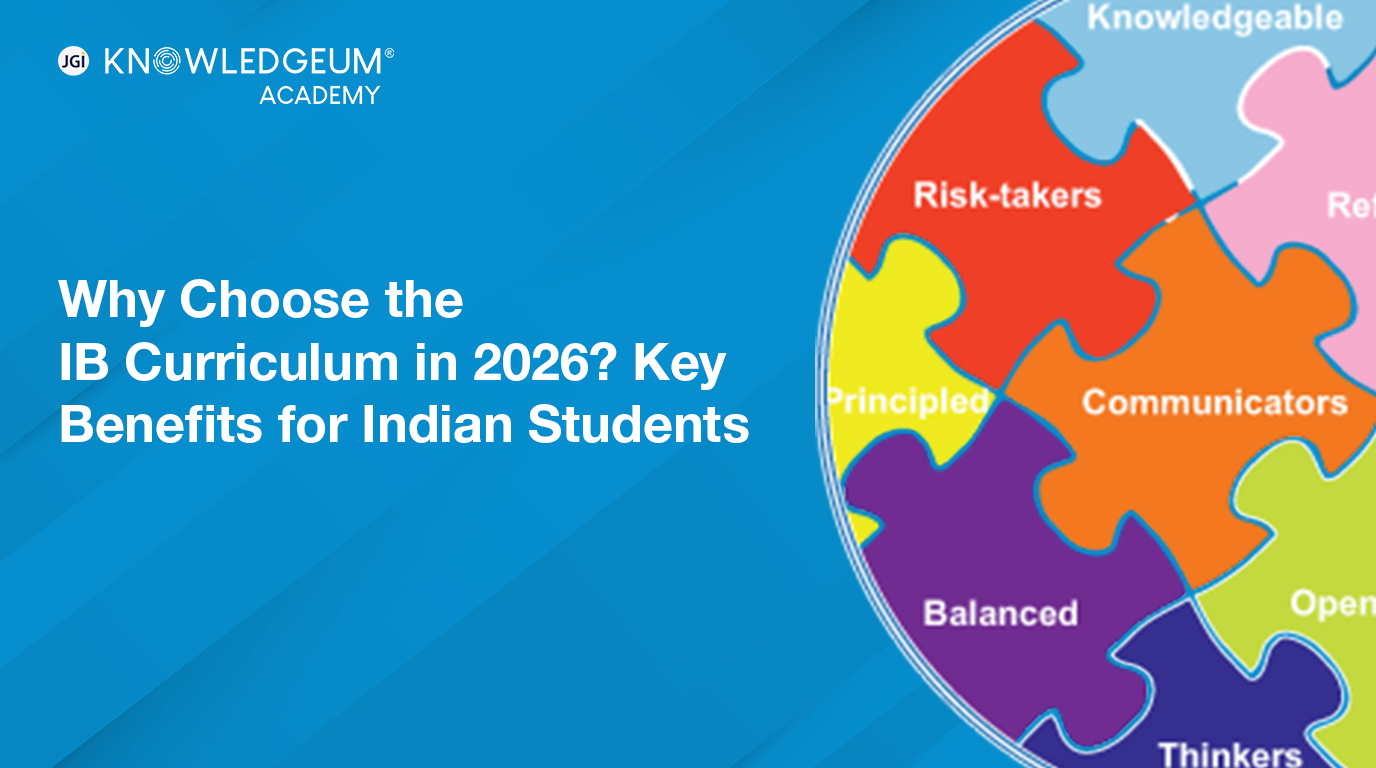
The educational system is evolving in 2026 and becoming more aligned with skill-based learning, global experiences, and cross-disciplinary thinking. The International Baccalaureate (IB) curriculum is the perfect fit for such a changing educational landscape. In the changing global landscape that is increasingly looking for adaptable and creative thinkers, the IB curriculum is emerging as the most suitable educational pathway for Indian learners. The demand for the best IB schools in Bangalore is rising because they are more than just rote learning and are focused on critical thinking, research, and leadership qualities. In addition to all these factors, the IB curriculum is also an attractive choice if you want to pursue higher studies abroad. In fact, the IB Diploma is recognised in over 150 countries, giving you a significant edge over others. Here is everything you need to know about the IB curriculum:
The International Baccalaureate curriculum is an internationally recognised education system for students aged 3 to 19 designed to develop inquiry-based and compassionate learners. It is quite distinct from other educational boards in its focus on conceptual understanding rather than memorisation.
Founded in Geneva, Switzerland (1968), the International Baccalaureate curriculum has spread to over 5,200 schools worldwide. These numbers reflect the growing demand and recognition for the curriculum that stays relevant across the globe. It is meant to provide a challenging academic education while at the same time imparting essential skills to you, such as critical thinking, intercultural understanding, and effective communication.
The IB system consists of four main programmes that cover different age groups:
| Programme | Age Group | Focus |
| Primary Years Programme (PYP) | 3–12 years | Inquiry-based learning and foundational skills |
| Middle Years Programme (MYP) | 11–16 years | Interdisciplinary understanding |
| Diploma Programme (DP) | 16–19 years | University preparation and research |
| Career-related Programme (CP) | 16–19 years | Career-focused education |
One of the unique characteristics of the DP is its focus on the core components, which are:
These components provide you with academic and practical learning experiences.
Traditional Indian boards, such as CBSE or state boards, tend to put more emphasis on examinations and rote learning through books. In contrast, the IB curriculum puts more emphasis on inquiry, discussions, and real-world applications.
For example, instead of rote learning and memorising facts for examinations, you are encouraged to think and research the topic and then present your findings. This helps you develop analytical and communication skills.
Another major difference is the assessment mechanism. Other Indian boards put more emphasis on final examinations. The IB assessment mechanism is more balanced and comprises coursework, presentations, research, and internal assessments conducted throughout the year.
| Feature | IB Curriculum | CBSE / Traditional Boards |
|---|---|---|
| Learning Style | Inquiry-based and conceptual | Textbook-driven |
| Assessment | Coursework + internal assessment | Mainly final exams |
| Skills Focus | Critical thinking, research | Memorisation and exams |
| Global Recognition | Very high | Mostly national |
| Curriculum Approach | Interdisciplinary | Subject-specific |
The popularity of the IB curriculum has been increasing in India over the past ten years. Many families see this not just as a system for passing exams, but as one that prepares students for the global workforce and international higher education.
Modern education is moving in a direction that requires skills and learning in a multidisciplinary way. The IB curriculum is a perfect fit in this regard. It focuses on
These are skills that are required in a world that is dominated by technology and artificial intelligence. Rather than teaching you what to think, this curriculum teaches you how to think.
One of the most compelling reasons for you to pursue the IB curriculum is its global recognition. Universities in countries like the USA, UK, Canada, and Australia place great value on the IB Diploma Programme due to its high academic standards. Universities value the research capabilities and independent thinking developed through the IB Diploma Programme. This global recognition of the IB curriculum may prove to be advantageous for you when seeking higher education abroad.
IB is a curriculum that requires you to think critically. DP core elements such as TOK and EE ensure you question things and develop logical arguments. These activities are important, as they develop skills that are important in achieving academic and professional success. At this level, you are able to develop independent research skills and communicate ideas effectively. Critical thinking is important, as it prepares you to tackle academic and research work in your future career.
The IB curriculum does not focus solely on academic work. There is the Creativity, Activity, Service aspect, where you are encouraged to take up sports, arts, and community service activities.
The CAS projects help you to venture out of your comfort zones and experience the world around you. Such activities could range from organising a charity event to learning to play a musical instrument or participating in environmental activities. This approach to holistic education is now recognised and appreciated by many universities and employers.
Another characteristic of the IB curriculum is that it nurtures an international mindset and cultural awareness. This is where learners are encouraged to explore global issues, understand different cultures, and develop empathy towards others.
This global awareness is essential to help learners succeed in a multicultural world.
The Ib curriculum is designed to encourage Interdisciplinary learning. This approach connects concepts across subjects, taking learning beyond rote memorisation and textbooks. Learners are supported to connect subjects with real-world problems. This helps develop research, critical thinking, and curiosity – skills that are essential in today’s technologically advanced world.
The IB curriculum 2026 reflects modern academic priorities and is geared to provide education to you in this rapidly changing world. It is an ideal choice because it is globally recognised and provides you with research abilities, creative skills and holistic development. The best IB schools in Bangalore ensure that these factors are in focus when delivering the education.
Looking for a globally recognised education pathway? Explore the IB Diploma Programme at Knowledgeum Academy and discover how IB learning prepares students for top universities worldwide
Which elements of the IB curriculum do you find interesting and challenging? Let us know in the comments section.
Yes, many Indian universities recognise the IB curriculum. The Association of Indian Universities provides equivalence certificates for IB learners applying to Indian colleges.
The IB is often considered more rigorous because it involves research projects, coursework, and continuous assessments rather than only final exams.
Yes, but learners may need additional preparation that is focused on the specific exam patterns of these tests, such as understanding the format, types of questions, and subject emphasis required for JEE or NEET.
IB learners develop skills such as critical thinking, research, communication, time management, and global awareness.
Yes, the International Baccalaureate (IB) curriculum is recognised by universities in more than 150 countries. Many top universities in the US, UK, Canada, Australia, and Europe value the IB Diploma Programme because it develops strong research, analytical, and independent learning skills.
The IB Diploma Programme offers subjects across six groups: Language and Literature, Language Acquisition, Individuals and Societies, Sciences, Mathematics, and The Arts. It also includes core components like Theory of Knowledge (TOK), Extended Essay (EE), and Creativity, Activity, Service (CAS).
The IB curriculum offers several benefits, including a strong focus on critical thinking and research, global recognition by universities, holistic development through activities like CAS, development of communication and collaboration skills, and preparation for international higher education.
Yes, learners with an IB Diploma can apply to Indian universities after obtaining an equivalence certificate from the Association of Indian Universities (AIU). Many Indian institutions accept IB scores for admission.







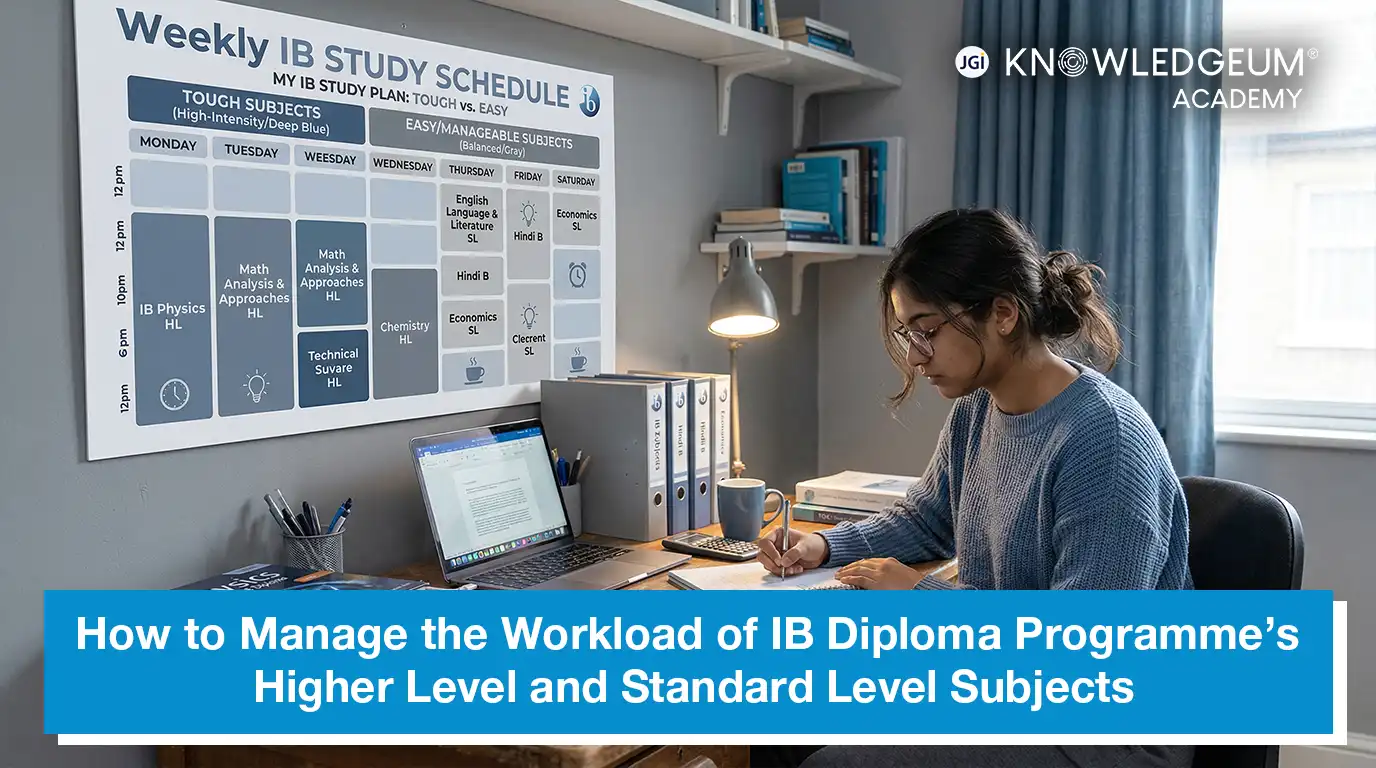
How to Manage the Workload of IB Diploma Programme Higher Level and Standard Level Subjects




 Brochure


Address
No.10, (old 271/A), 1st Main Road


Quick links
© Knowledgeum


 Knowledgeum Experience