Apply Now
06-02-2026

The Art of Answer Writing: Tips to Impress the Examiner 

Table of Contents

Scoring well in any exam is not just about how much  students have prepared; it is about how effectively students present their answers. Writing answers during examinations involves more than merely recording information on paper. Students must follow a clear structure, maintain legible handwriting, and present answers effectively, including diagrams, flowcharts, and examples where required.

Whether it is a school final or an IBDP exam, the way students present their answers matters. Here, writing a precise answer includes:

A precise explanation

A relevant examples and reasons

If necessary, provide a neatly labelled diagram.

These practices help students to improve their overall scores and ensure a positive impression during evaluations.

Why Answer Writing Matters and How Marks are Awarded?

Kittur Rani Chennamma

An answer-writing strategy is a planned method of structuring and presenting answers in examinations. It helps students to:

  • Stay organised
  • Express ideas clearly
  • Complete all answers on time
  • Avoid unnecessary information
  • Highlight the most important points effectively

Presenting answers during the exams demonstrates students’ comprehension of the subjects.

It is also used to assess how well they can interpret the question, organise their thoughts, and present relevant information within a given time frame.

While evaluating the answer scripts, the evaluators look for the correct answers, which are well organised, easy to read, and directly aligned with the question.

The marking scheme usually varies depending on the type of question.

  • Objective questions: It is assessed solely based on accuracy
  • Short-answer questions: It is assessed based on the key points and clarity
  • Long-answer and essay-type questions: It is assessed based on conceptual understanding, logical structure, coherence, relevance, use of examples or diagrams, and overall presentation.

Thereby, mastering answer writing ensures students convert their knowledge into marks effectively and making it a crucial skill for exam success.

* Note: 

Examiners do not give marks based on length; they focus on content quality and relevance.

Step-by-Step Strategy for Writing High-Scoring Exam Answers

Presenting answers in a well-structured manner plays an equally important role in overall exam performance. Thus, students should thoroughly prepare for their examinations by reviewing their notes and anticipating the question paper.

In addition to their preparations, students should possess strong skills in writing or presenting answers to specific questions in a clear and concise manner. This is because even a minor error arising from carelessness can adversely affect a student’s final results.

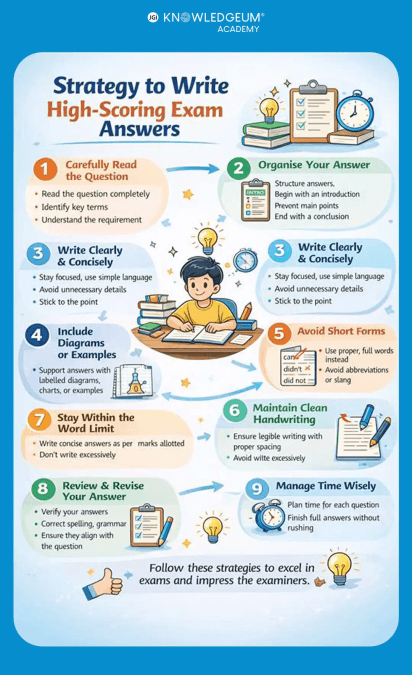
Step 1: Plan before writing

Step 2: Understand the question properly

Step 3: Write concisely to meet exam requirements

Step 4: Keep answers focused and concise

Step 5: Use Examples, Diagrams & Flowcharts to score more

Step 6: Avoid time-wasting presentation habits

Step 7: Use the ideal structure: Intro → Points → Example → Conclusion

Step 8: Do a final check on the answer scripts.

Step 9: Stay calm

Here is a brief explanation of these steps:

Here are a few simple exam writing tips to help you understand how to answer exam questions.
Kittur Rani Chennamma

Plan Before Writing

  • Students should carefully read the entire question paper and instructions during the initial 15–20 minutes provided
  • Determine the order in which questions should be attempted
  • Later, they should plan their answers according to the time allotted
  • Effective time management is essential in examinations, as students are required to complete the paper within a limited duration
  • Since time pressure can be challenging, students should use every minute wisely.

Understand the Question Properly

Before beginning with the answers, students should first analyse the question carefully by:

  • Learning about the key terminology 
  • Phrases about what is being asked
  • Later on students can decide whether the question requires explanation, justification or only a definition.

Structure the Answers Properly

Maintain Neatness and Easy to Understand

  • Handwriting plays a key role in how answer scripts are evaluated
  • It is easy for an examiner to evaluate the answer scripts that are clean, well organised, and easy to read. 
  • Thus, to make evaluators easily understand the content, students should
    • Write legibly 
    • Maintain proper spacing between answers and question numbers
    • Diagrams and flowcharts should be drawn neatly and labelled clearly using formal terminology
    • Avoid striking out or overwriting their answers, as these practices can make the answer script appear untidy and may reduce its readability.

Write to the Point: What Examiners Reward

  • Avoid unnecessary information and focus on writing relevant, precise, and meaningful content
  • Before beginning an answer, carefully read and understand the question to identify what is required
  • Subjects, such as Biology and other science-related disciplines, include only essential facts, definitions, and explanations
  •  Students should limit their answers to the required length and avoid writing excessively merely to fill pages
  • Although many students believe that longer answers fetch higher marks, this is a common misconception
  •  Examiners prioritise accuracy, relevance, clarity, and a proper presentation more than the length of the response.

Provide a Well-Structured Answer

  • Students should make their answers more informative by:
    • Presenting points clearly
    • Adding relevant examples
    • Drawing neatly labelled diagrams wherever appropriate
  • In many subjects, examiners consider elements such as correct equations, diagrams, subheadings, and neat handwriting while allotting marks
  • Students should avoid using short forms or contractions in the answer booklet. 

For instance, "didn't" and "can't" should be spelt out as "did not" and "can not".

In general, they should use simple, clear language to explain their answers and not use too many words in lines. Proper spacing improves readability and helps the examiner evaluate answers easily.

Avoid Time-Wasting Presentation Habits

  • It is often observed that some students attempt to decorate their answer scripts by using multiple colours, such as blue, green, and black pens for headings or underlines
  •  This practice does not earn any extra marks. This practice wastes valuable time that could be better spent thinking and writing answers
  • Therefore, as per standard examination guidelines, students should use only two pens:
    • A black pen for headings
    • A blue pen for writing the main text
  • While drawing diagrams, students should always use a pencil
  • This practice keeps the answer scripts neat and simple and helps students manage their time more effectively.

Write Structured Answers and Include Scoring Criteria for Exams

Students should never rush while writing their answers. They should carefully read the question and plan the structure of their response.

  • For short and very short answers, explanations may be given in five to six points or in one or two brief paragraphs. 
  • Long or essay-type answers need extra attention and proper planning. Unlike short answers, they require a clear structure so that ideas are presented logically and neatly.

A good long answer should usually include three main parts:

  • An introduction
  • A few body paragraphs, 
  • A conclusion.

For example, if the question is “Write a short note on the Modern Periodic Table,” students can organise their answer in the following way:

Introduction

  • Begin with a simple definition of the Modern Periodic Table. Also add one or two lines about its development or why it was introduced.

Body Paragraphs

  • In the main part of the answer, explain important features such as periods, groups, and blocks. 
  • Write about how periods are arranged and why they are important.
  • Explain groups and how elements are classified based on their properties. 
  • Finally, describe the s, p, d, and f blocks with suitable examples to show understanding.

Conclusion

  • End with a short summary that highlights the importance and usefulness of the Modern Periodic Table in chemistry.

Overall, all long-type answers should always be written in clear paragraphs or with well-organised points. Using simple and direct language makes the answers easier to read and also helps the examiner to evaluate the answers.

Conclusion

  • A brief summary highlighting the importance of the Modern Periodic Table

Always present answers in clear paragraphs or well-organised points, using simple language. This helps ensure readability and makes evaluation easier for the examiner.

Final Minute Review Before Submitting

  • After finishing the exam, students should take a few minutes to go through their answer scripts
  • Reading through the paper more than once often helps in spotting small errors that may have been missed earlier
  • This final check also helps confirm that every question has been attempted and that important details such as
    • Name and Class 
    • The roll number, date and other details
  • A careful review can prevent avoidable mistakes.

Stay Calm 

  • It is normal for students to come across a few questions they are unsure about
  • In such moments, getting anxious can make it harder to think clearly. Instead of panicking, students should
    • Pause for a while
    • Take a moment to recollect the concepts
    • Try to attempt the question in a calm and organised way. 
  • Thus, staying relaxed and focused allows students to use their knowledge more effectively and make better use of the time available.

By following these tips, students can write precise, well-structured answers and perform exceptionally in their examinations.

👉 Click Here to Download the Exam Answer Writing Checklist.

Most Common Mistakes to Avoid While Writing Answers

Studying without a proper plan may affect academic performance. Similarly, attempting questions in an exam without a plan can lead to poor time management, increased anxiety, careless errors, and a lower overall score.

Here are some top ten mistakes which students should learn and avoid during their examinations to score the best.

  • Neglect presentation
  • Ignoring key terminologies
  • Ignoring marks distribution
  • Overwriting or underwriting
  • Not reading the question carefully
  • Failure to follow the given instructions
  • Guessing or providing incorrect information
  • Spending too much time on a single question
  • Provide only one-word or single-sentence answers when detailed explanations are required

Conclusion

Writing a perfect answer in an exam is not just about knowing the content; it is about presenting that knowledge logically and effectively.

Even well-prepared students sometimes lose marks because their answers are poorly structured or unclear.

Accordingly, every student should ensure that their answer scripts look neat and clean by:

  • Leaving space before starting the next question
  • Write the answers in bullet points to avoid clustering all sentences together.

This practice helps students keep their answer scripts neatly organised.

Mastering the art of answer writing can significantly improve the overall scores

Best of luck!

Stay tuned with https://knowledgeumacademy.in/blogs to learn more in detail about the art of answer writing and other related articles.

Frequently Asked Questions (FAQs)

Diagrams are important during examinations, as they support and validate the answer.

Students can enhance the persuasiveness of an answer by:
  • Presenting a clear viewpoint
  • If necessary, students can strengthen their answers by incorporating facts and examples and diagrams. 
Thus, students should organise the content well, including the proper introduction, body, and conclusion.

Time management is crucial during exams. To maintain time, students should keep track of it by periodically glancing at the clock or watch.

An answer consists of the following basic components: the introduction, body, conclusion, flow, and presentation.

Students can refer to previous years' question papers and model question papers to gain an idea about the question paper pattern before the examinations.

Testimonials


Latest Blogs

IB Education System in India – Everything You Need to Know

Why Choose the IB Curriculum in 2026? Key Benefits for Indian Students

Top Scholarships for IB Students in India – 2026 Opportunities

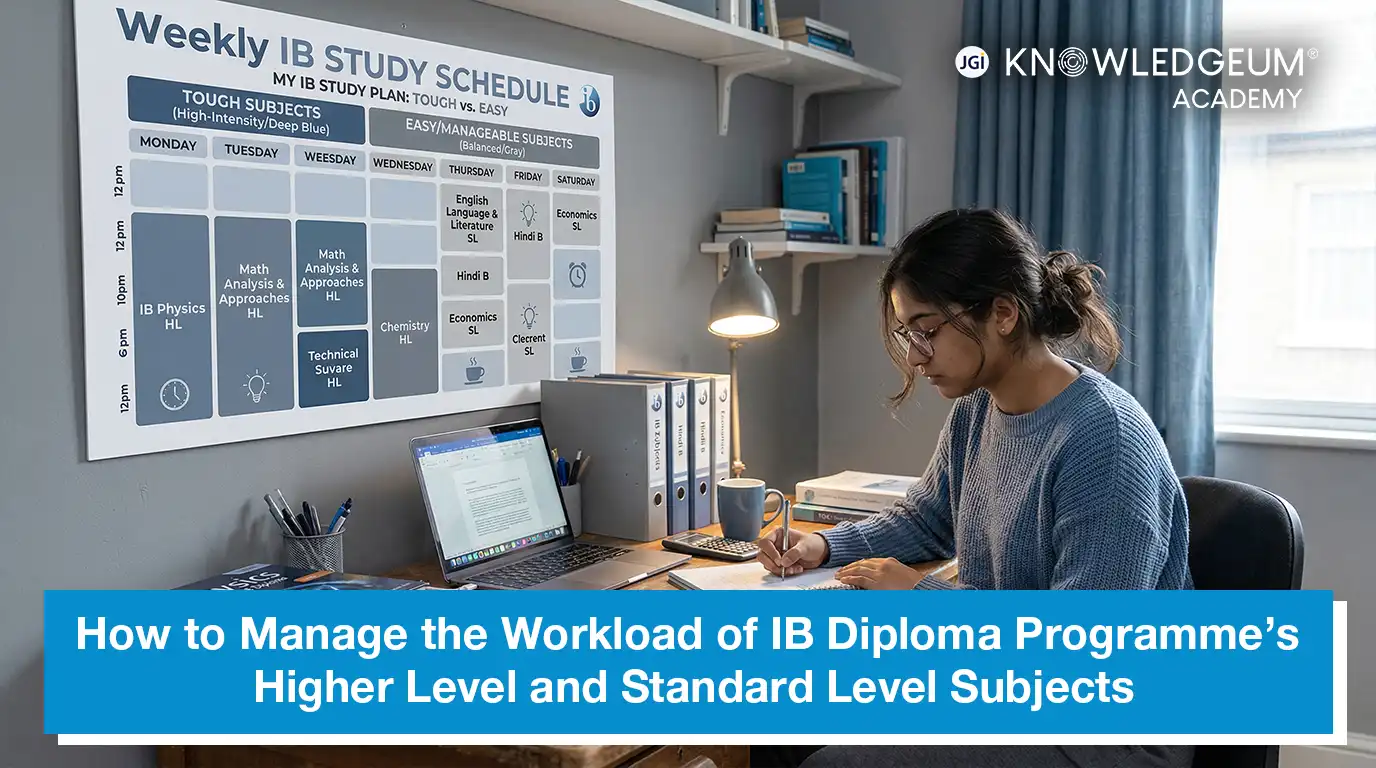
How to Manage the Workload of IB Diploma Programme Higher Level and Standard Level Subjects

How to Choose the Best IB School in Bangalore


Knowledgeumites


Enquire
Now
Brochure
logo logo logo

© Knowledgeum

News
IBDP Results 2025: A Journey of Growth, Discovery, and Achievement
Admissions 2025
A Transformative Journey of Learning and Growth
04-03-2025
The Student Council of Knowledgeum Academy
Applications Invited for
Grade 11 & 12
Event
Knowledgeum Academy Shines at JNMUN IX
17th July 2025
Conexión
June 2025 (Volume 4, Issue 6)
International Student
Kommunique
Edition 1
News
IB Subjects for Engineering: A Guide to Success
News
IB Subjects for Pursuing Medicine in the USA
News
Does Harvard Accept IB Students? A Guide to IB and Harvard Admissions
IBDP 2025 Success Rate
90%
Highest Grade Achieved
41/45
School Average Score
32/45
Knowledgeum Knowledgeum Experience