Choosing the right IB Math track is important, as it builds a strong foundation for university-level education. So, questions like ‘what is IB Math?’ or ‘what is Math AI?’ are quite common when it comes to IBDP. IB Math AA will take you into the world of abstract Math and theory, whereas IB Math AI will lead you into practical, real-world applications. This guide will take you through the IB Mathematics: Applications & Interpretation (AI) structure, its focus areas, sample internal assessment ideas for AI, and real-life applications.
The IB Diploma Programme (IBDP) has six subject groups, where Mathematics belongs to group 5 and makes up one of the core areas. The IBDP curriculum offers flexibility to approach Maths in ways that complement your academic strengths and weaknesses.
IB Math Analysis & Approaches (AA) covers algebra and calculus, where abstract, theoretical Math enthusiasts can thrive.
IB Math Applications & Interpretation (AI) covers topics like statistics and modelling. It ensures you are ready to handle real-world situations through the lens of mathematics.
Both IB Maths subjects are available at Standard Level (SL) and Higher Level (HL), giving flexibility to choose the difficulty level based on your interests.
IB Mathematics: Applications and Interpretation, commonly referred to as Maths AI, focuses on using Mathematics as a tool to solve real-world problems. It makes a strong foundation for careers in business, economics, and psychology, where practical applications and statistical modelling are needed. Here is how IB Maths AI is structured:
Maths AA is a better fit for those interested in exploring abstract and theoretical Mathematical concepts. Maths AI is for learners who want to know how Maths connects to economics, business, psychology, or even environmental science.
All the IB subjects have Standard-Level and Higher-Level curricula, offering you the flexibility to choose the level that suits their academic strengths and career goals. Here is how IB Math AI differs at SL and HL -
IB Maths AI Standard Level (SL): AI SL focuses on applied topics like basic statistics, financial math, and simple models. It is ideal if you are heading into business, psychology, design, or social sciences.
IB Maths AI Higher Level (HL): AI HL expands and covers topics like advanced probability distributions, and deeper statistical analysis. It is a perfect choice if you are aiming at economics, finance, actuarial science, or data analytics.
In simple words, AI SL teaches applied fundamentals, whereas AI HL prepares you for technical depth in applied fields.
Math AI excels in its ability to seamlessly integrate with daily life.
Statistics in everyday life: Do you want to interpret election polls or analyse survey data? AI will equip you with all the necessary statistical skills.
Finance and business Mathematics: Understand how loans and mortgages work and learn about investments in AI. It will give you tools to manage money effectively.
Modelling in sciences and environment: It is interesting how IB Math AI provides methods to model population growth, global warming, natural disasters or even disease spread.
As the world is moving towards big data and artificial intelligence, a deeper understanding of statistics and data interpretation will play an important role in technology and data-driven careers.
If you are wondering what exactly is studied in AI, then here are some of the topics covered in the Maths IB AI SL textbook and a few concepts from HL.
So, if you look at this mix, you will realise how this mix of topics introduces you to the practical relevance of every concept. It is to ensure the real-world compatibility of AI and to create a strong foundation for university-level education.
The IB Internal Assessment is an important part of the curriculum where you can choose a topic and apply Math AI. It gives a chance to get creative with numbers and checks understanding of how AI works in real-life situations.
Sports & Performance Analysis can be used to explore a sports-based topic. You can do this by analysing a cricketer’s batting average, using regression to predict football scores, or comparing Olympic records across decades.
Environmental Studies is where you can examine environmental data by modelling rising global temperatures. It can also include analysing rainfall or pollution levels in your city or studying deforestation patterns using statistical methods.
Business & Economics helps Investigate economic behaviour by studying how price changes affect consumers. It can also focus on modelling profit margins and cost structures or tracking inflation trends over the years.
Social Data can be used to understand social patterns by exploring social media engagement and growth metrics. Consider topics like analysing smartphone usage trends or surveying stress levels among learners during examination periods.
The best part about Maths IA in AI is that you can have the freedom to make it personal and relatable.
So, to sum it up, IB Maths AI is focused on making Maths practical and relatable through the study of applications, data, and modelling. Even if it may not always cater to learners pursuing engineering, it’s perfect for learners pursuing business, economics, psychology, and applied sciences. If you opt for IB Math AI, the curriculum will ensure you are prepared with skills that you will use long after your IB Diploma Programme is over. So, if it is the right fit for your career goals and strengths, choose Applications & Interpretation (AI) to extend the understanding of Mathematics.
Get in touch with Knowledgeum Academy to understand more about the IB curriculum.
It’s the Applications & Interpretation course in IB Mathematics, aimed at making real-world Math learning and application interesting.
While both Maths AA and AI have their challenges, AI is considered a little easier than AA as it focuses on practical aspects, whereas AA is abstract.
The university applications for engineering courses prefer IB Maths AA, ideally at HL. If you opt for AI, it may not be accepted at most of the universities.
The internal assessment topics for Maths AI can be sports analysis, financial modelling, climate studies, and social data.
IB Maths AI will prepare you for careers in business, economics, psychology, political science, data analysis, and social sciences.







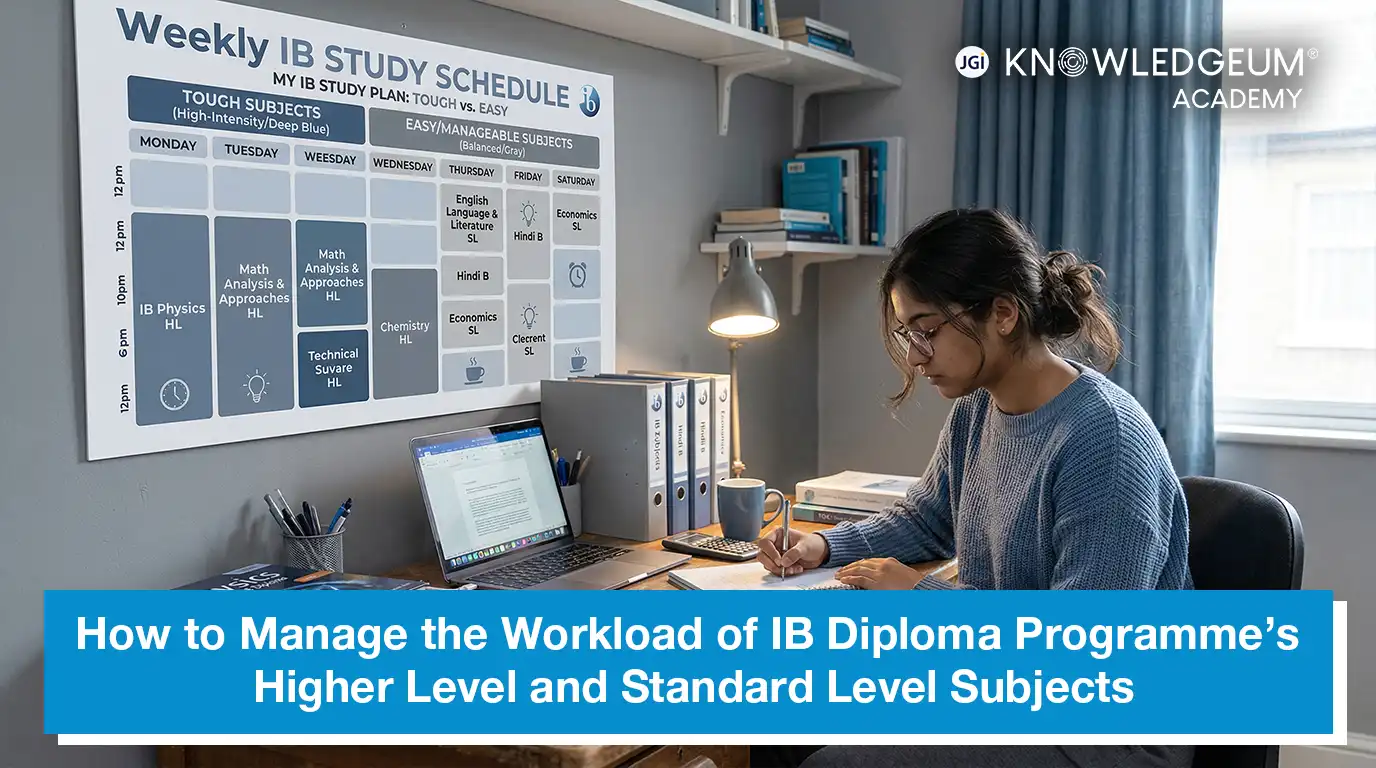
How to Manage the Workload of IB Diploma Programme Higher Level and Standard Level Subjects





 Brochure


Address
No.10, (old 271/A), 1st Main Road


Quick links
© Knowledgeum



 Knowledgeum Experience