Table of Contents
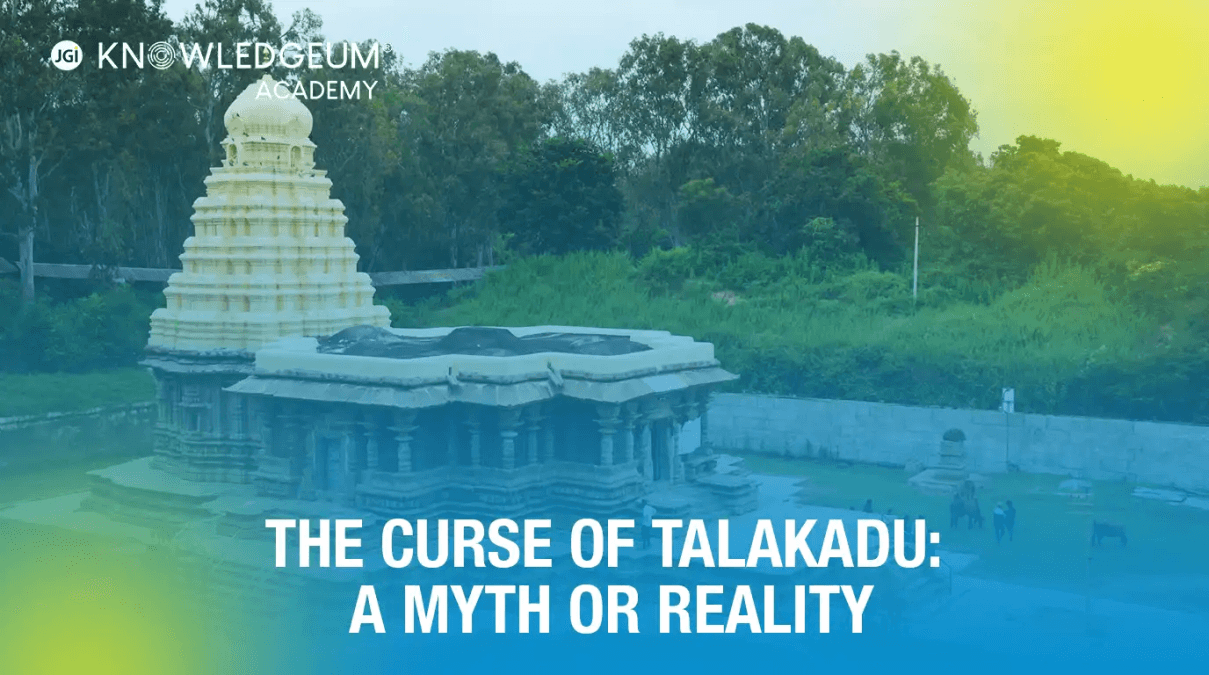
The Curse of Talakadu refers to a legendary curse attributed to Queen Alamelamma in the 16th century, believed to have buried the town under sand.
While folklore attributes this to divine retribution, scientists explain it through river diversion, erosion, and wind-driven sand deposition.
The story of the Curse of Talakadu reflects a blend of folklore and environmental history. Although local tradition credits Queen Alamelamma’s curse for the town’s burial under sand, researchers point to natural causes such as river course shifts, erosion, and wind-driven sand accumulation as the more likely explanations.
Talakadu is a sand-dune-covered town on the left bank of the Kaveri River (anglicised as Cauvery), 45 kilometres from Mysore and 133 kilometres from Bangalore, in Karnataka, India. Beneath the sand dunes lie the remnants of an ancient town that once flourished with over 30 temples. Among these temples, Talakadu is renowned for the Vaidyanatheshwara Temple, dedicated to Lord Shiva.
Talakadu was once the capital of the Gangas, who ruled Mysore and the area around it. The town has been a witness to the rise and fall of several great kingdoms, including the Cholas, Pallavas, Gangas, Vijayanagars, and Hoysalas. This town derives its name from two local chieftains, Tala and Kada, and is called Talakadu.
This town is known for its large dunes that have buried numerous Hindu temples over the centuries. The excavations have revealed some of the most prominent temples, including the Pathaleshwara and Kritinarayana. Other temples of this region include:
Talakadu attracts tourists both for its religious significance and eroded sandstone structures that have emerged from the sand dunes over time.
What sets Talakadu town apart is not just its history. It is the enduring legend that claims the town was cursed—condemned to be swallowed by sand forever.
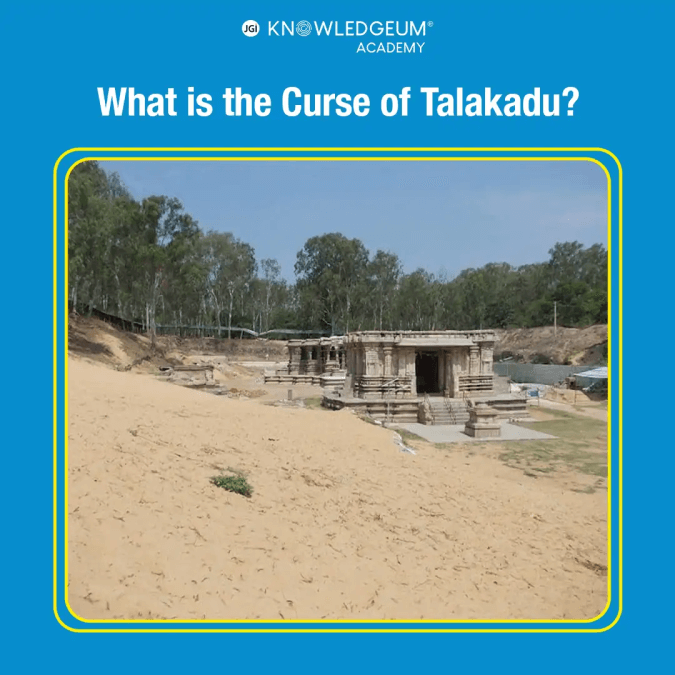
In local folklore, the Curse of Talakadu is believed to be a miraculous event linked to historical changes in the region. Over time, this belief became part of popular tradition, even though historians and scientists explain Talakadu’s condition mainly through natural and environmental factors rather than supernatural causes.
This belief is supported by three strange events that are still visible today:
All these events, linked to an apparent curse by a pious lady, have defied logic.
Many legends attempt to explain the possible reasons for the "Curse of Talakadu."
According to local belief, during the early 16th century, the Mysore Wodeyars took over Srirangapattana from the Vijayanagara rulers. Rangaraya, also known as Tirumalaraja, was the viceroy of Vijayanagara and ruled Srirangapattana at the time.
Following the takeover, Queen Alamelamma fled to Talakadu, carrying her personal jewellery. The Mysore Wodeyars accused her of taking jewels belonging to the famous temple of Goddess Ranganayaki, which had been renovated by Rangaraya, and sent soldiers to retrieve them.
When the soldiers confronted her, Alamelamma gave them her pearl nose ring but escaped with the rest of her jewellery. She fled to the banks of the river Kaveri at Malangi, and, left with no choice and unwilling to surrender, she threw herself and her remaining jewels into the river.
Before dying, she is said to have cursed the region in three ways:
Remarkably, folklore holds that these curses came true. Talakadu is now buried under sand dunes, Malangi has mysterious whirlpools, and the Mysore royal family historically experienced succession difficulties.
Despite the numerous rational studies conducted since then, it appeared that Alamelamma's curse had indeed come true.

Alamelamma, regarded in folklore as the queen and consort of King Tirumalaraja of Srirangapatna, is believed to have been devoted to the Talakadu temples. Legends say she frequently offered precious ornaments to the Lord of Ranganatha at Srirangapatna.
After her husband’s illness and eventual death, political control passed to the Mysore Wodeyars. When soldiers pursued her to seize her jewels, Alamelamma fled toward Talakadu. Eventually, she reached Malangi, on the banks of the Kaveri River.
Faced with captivity, she threw herself in the river with her jewels, choosing death over dishonour.
“Talakadu maralagali, Malangi maduvagali, Mysuru dhorege makkalilladhe hogali”.Meaning:
|
While the legend offers a dramatic explanation, science provides a far more grounded perspective.
In 1991, the Archaeological Survey of India (ASI) uncovered the remains of over 30 temples that had been buried under layers of sand in Talakadu. These findings confirmed that the town’s transformation was not only a matter of folklore but also involved natural and geomorphic processes.
Historical research points to human intervention as one of the key factors. During the 17th century, an upstream weir or dam was constructed north of Talakadu, diverting the Kaveri River flow into the Madha Vamantri canal. This significantly reduced water levels downstream, leaving the riverbed exposed.
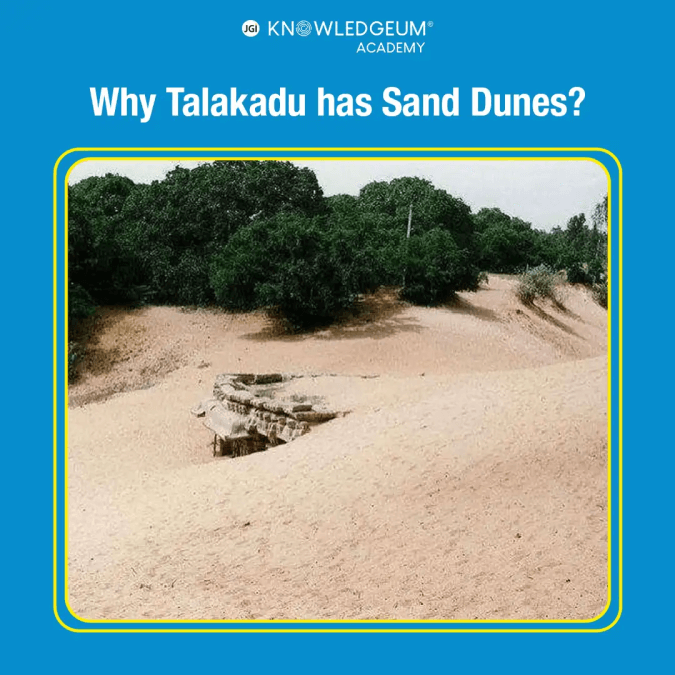
Once exposed, the loose sand was gradually carried by strong monsoon winds toward Talakadu. Over centuries, this continuous process formed migrating sand dunes that eventually engulfed temples, homes, and entire settlements, giving rise to the legend of the “buried city”.
Over time, entire temples disappeared beneath these shifting sands.
Historically, Talakadu was known by several names:
The town is especially famous for Panchalinga Darshana, a pilgrimage involving five ancient Shiva temples comprising:
Talakadu, which represents a typical sand dune, is situated along the left bank of the Kaveri River. According to the Science view, the main source of the sand in Talakadu is the point bar deposit along the left bank of the Kaveri.
However, this stretch upstream has a weir built approximately 400 years ago that diverted water from the Kaveri into the Madha Vamantri canal, resulting in a lower water level in the point bar deposit downstream and exposing its sand to monsoon winds blowing from the southwest (SW) to the northeast (NE) towards old Talakadu.
The settlements, along with the crosswinds blowing from northwest (NW) to southeast (SE) in the valley, acted as barriers for the sand-laden monsoon winds, leading to the development of sand dunes that gradually migrated and buried temples and many old settlements.
The curse of Talakadu survives because it offers a powerful narrative—one that blends history, faith, and visible consequences.
The Curse of Talakadu is a popular legend based on the story of Queen Alamelamma. This curse has been passed down through generations as an explanation for the town's peculiar change. Popular belief holds that Queen Alamelamma’s curse buried Talakadu under sand. This belief holds deep cultural and emotional significance.
The question remains: Was it truly a curse, or can the events be explained scientifically?
From a scientific perspective, researchers suggest that natural factors contributed to Talakadu’s burial. These factors can be explained by:
These environmental phenomena are natural and common in riverine regions. It provides a logical explanation for the landscape changes seen in Talakadu.
However, the belief in the curse continues to shape local traditions, rituals, and festivals, especially during the Panchalinga Darshana.
For devotees and locals, the legend represents faith, devotion, and respect for divine power.
A Balanced Verdict:
The curse of Talakadu is best understood as a powerful myth rooted in history, faith, and folklore, rather than a literal supernatural event. While science offers clear explanations for the physical changes in the region, the legend remains an integral part of Talakadu’s identity, enriching its spiritual and cultural heritage.
Recent archaeological interest and tourism studies continue to highlight Talakadu’s historical significance.
Talakadu is ideal for a day trip from Mysore or Bengaluru.
Karnataka Tourism reports that the Talakadu town has excellent road connections with other cities.
By Air:
The nearest airport is in Mysore (approx. 50 km)
By Road:
Well-connected by highways from Mysore and Bengaluru
By Train:
The nearest railway station is in Mysore (approx. 50 km)
Another option is Mandya Railway Station (approx. 55 km)
Talakadu offers a unique glimpse into history, culture, and the interplay between legend and nature. Visitors can experience both its mysterious charm and its historical significance, making it a fascinating destination for those interested in Karnataka’s rich heritage.
Visit Talakadu for its mystery and its uniqueness.
Stay tuned with https://knowledgeumacademy.in/blogs to learn more in detail about the historical evidence and folklore behind the curse of Talakadu and other related articles.
What do you think about the Curse of Talakadu?
Is it a myth or science?
Share your thoughts with us.












How to Manage the Workload of IB Diploma Programme Higher Level and Standard Level Subjects





 Brochure


Address
No.10, (old 271/A), 1st Main Road


Quick links
© Knowledgeum



 Knowledgeum Experience