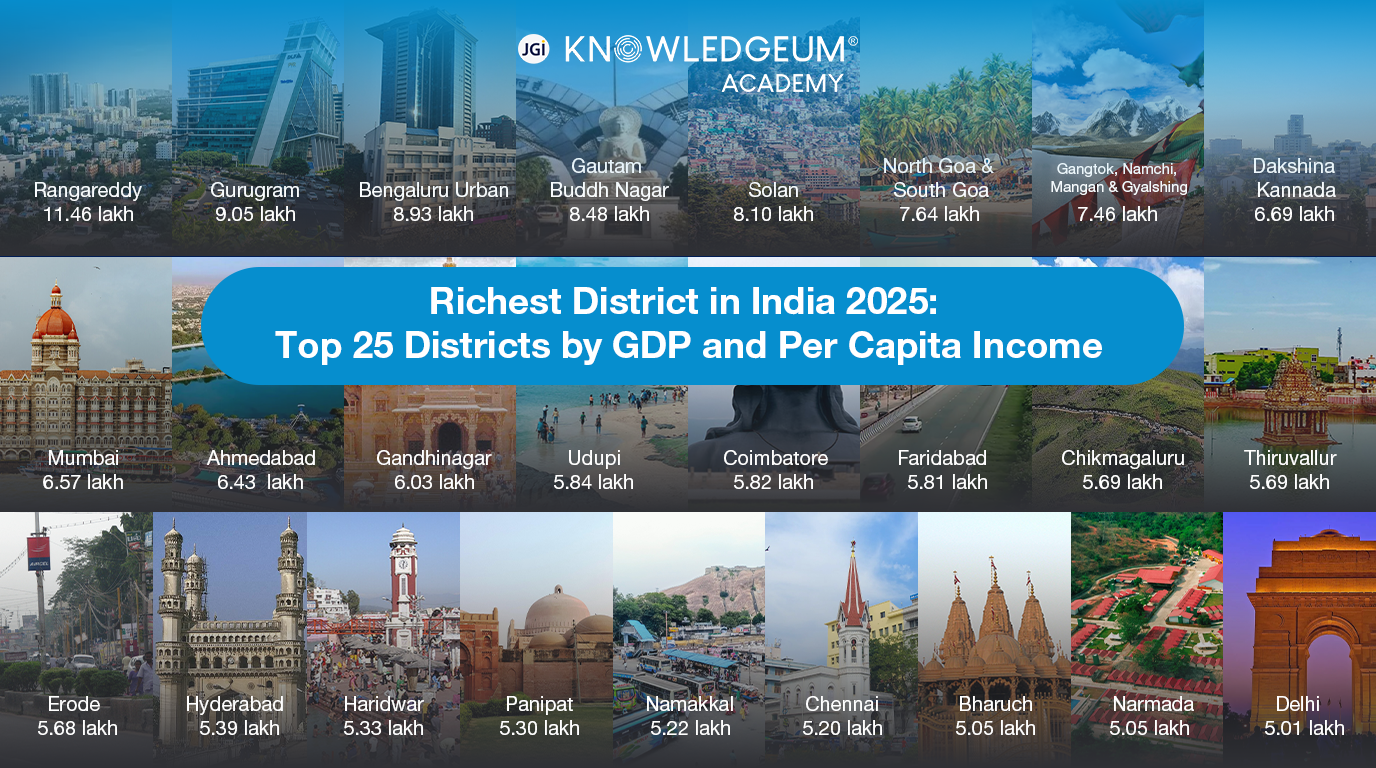
The richest district in India is Rangareddy, Telangana, with a GDP per capita of ₹11.46 lakh, driven by its IT hubs and rapid urban development. It is followed by Gurugram, Haryana (₹9.05 lakh), known for its corporate clusters and high-income workforce, and Bengaluru Urban, Karnataka (₹8.93 lakh), powered by India’s tech and startup economy. Gautam Buddh Nagar, Uttar Pradesh (₹8.48 lakh), and Solan, Himachal Pradesh (₹8.10 lakh), also rank among the top richest districts due to their strong industrial growth, infrastructure, and rising economic productivity.
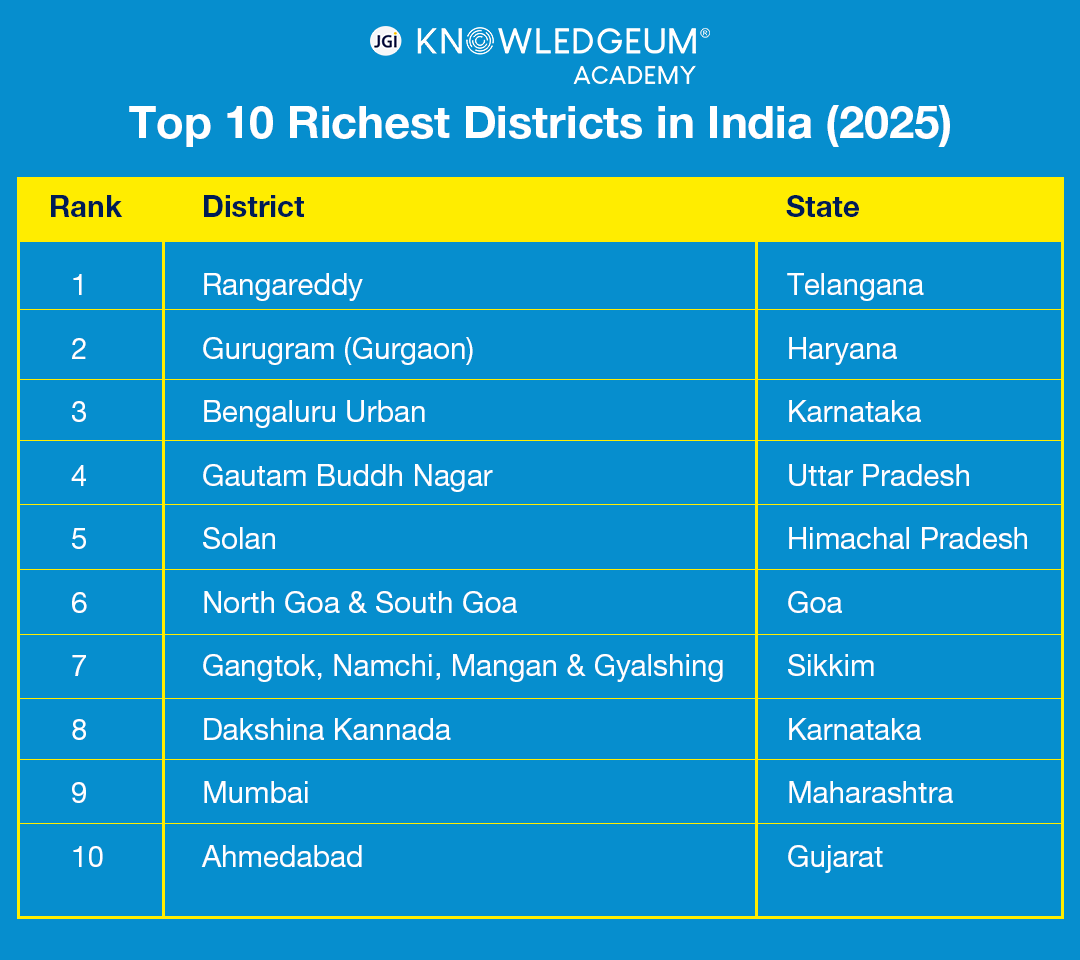
| Rank | District | State | GDP per capita (Rs) |
| 1 | Rangareddy | Telangana | 11.46 lakh |
| 2 | Gurugram (Gurgaon) | Haryana | 9.05 lakh |
| 3 | Bengaluru Urban | Karnataka | 8.93 lakh |
| 4 | Gautam Buddh Nagar | Uttar Pradesh | 8.48 lakh |
| 5 | Solan | Himachal Pradesh | 8.10 lakh |
| 6 | North Goa & South Goa | Goa | 7.64 lakh |
| 7 | Gangtok, Namchi, Mangan & Gyalshing | Sikkim | 7.46 lakh |
| 8 | Dakshina Kannada | Karnataka | 6.69 lakh |
| 9 | Mumbai | Maharashtra | 6.57 lakh |
| 10 | Ahmedabad | Gujarat | 6.43 lakh |
The richest district in India is Rangareddy in Telangana, with a GDP per capita of ₹11.46 lakh (2025). Rangareddy leads because of its massive IT hubs and global companies in HITEC City and Gachibowli, rapid infrastructure growth, and a highly skilled workforce that drives strong economic productivity.
The richness of a district in India is mainly measured using GDP (Gross Domestic Product) and GDP per capita, which show how much economic value the district produces and how much income is generated per person.
A high GDP indicates strong industries and overall economic output, while high GDP per capita reflects better productivity and higher earnings for residents.
Other indicators like employment levels, industrial diversification, infrastructure quality, business investment, and the presence of high-value sectors (IT, finance, manufacturing, technology, and services) also help determine how economically rich a district is.
Districts that score well across these metrics are considered the richest and most economically advanced.
GDP (Gross Domestic Product) is calculated by adding up the total value of all goods and services produced within a country or region during a specific period (usually a year).
In simple terms, it shows how much money the economy is generating.
There are three main ways to calculate GDP:
GDP = Consumption (people buying goods/services)
GDP = Total income earned by everyone in the economy
(wages + profits + interest + rent)
GDP = Value of all final goods and services produced
(across agriculture, industry, and services)
Governments and economists often cross-check all three to obtain the most accurate picture.
When the GDP is growing, it means the economy is producing more, people are earning more, and businesses are expanding.
Per capita GDP is calculated by dividing the total GDP of a region by its total population.
It shows how much economic output or income is produced per person, making it one of the best indicators of how wealthy or productive a district is.
Per Capita GDP = Total GDP ÷ Total Population
Example: If a district produces goods and services worth ₹1,00,000 crore in a year
and has 1 crore people, then:
Per Capita GDP = 1,00,000 crore ÷ 1 crore = ₹1,00,000 per person
Per capita GDP helps compare districts of different sizes.
A district with a smaller population but strong industries (like Rangareddy or Gurugram) can have very high per capita GDP, even higher than bigger cities.
Here’s a list of the top 25 richest districts in India.
| Rank | District | State | GDP per capita (Rs) |
| 1 | Rangareddy | Telangana | 11.46 lakh |
| 2 | Gurugram (Gurgaon) | Haryana | 9.05 lakh |
| 3 | Bengaluru Urban | Karnataka | 8.93 lakh |
| 4 | Gautam Buddh Nagar | Uttar Pradesh | 8.48 lakh |
| 5 | Solan | Himachal Pradesh | 8.10 lakh |
| 6 | North Goa & South Goa | Goa | 7.64 lakh |
| 7 | Gangtok, Namchi, Mangan & Gyalshing | Sikkim | 7.46 lakh |
| 8 | Dakshina Kannada | Karnataka | 6.69 lakh |
| 9 | Mumbai | Maharashtra | 6.57 lakh |
| 10 | Ahmedabad | Gujarat | 6.43 lakh |
| 11 | Gandhinagar | Gujarat | 6.03 lakh |
| 12 | Udupi | Karnataka | 5.84 lakh |
| 13 | Coimbatore | Tamil nadu | 5.82 lakh |
| 14 | Faridabad | Haryana | 5.81 lakh |
| 15 | Chikmagaluru | Karnataka | 5.69 lakh |
| 16 | Thiruvallur | Tamil nadu | 5.69 lakh |
| 17 | Erode | Tamil nadu | 5.68 lakh |
| 18 | Hyderabad | Telangana | 5.39 lakh |
| 19 | Haridwar | Uttarakhand | 5.33 lakh |
| 20 | Panipat | Haryana | 5.30 lakh |
| 21 | Namakkal | Tamil nadu | 5.22 lakh |
| 22 | Chennai | Tamil nadu | 5.20 lakh |
| 23 | Bharuch | Gujarat | 5.05 lakh |
| 24 | Narmada | Gujarat | 5.05 lakh |
| 25 | NCT – National Capital Territory – Delhi | Delhi | 5.01 lakh |
Rangareddy is India’s richest district because it houses Hyderabad’s biggest IT corridors, including HITEC City and Gachibowli. The presence of MNCs, tech parks, and high-income skilled professionals creates massive economic output. Pharma, biotech, real estate, and financial services also add strong value. With fast urban growth and high-paying jobs, its per capita GDP remains the highest in the country.
Gurugram’s economy is driven by corporate offices, IT companies, and global service-sector giants. It attracts high-income professionals working in finance, consulting, technology, and outsourcing. Modern infrastructure, business parks, and rapid urbanisation further increase productivity. The district’s combination of high-value services and skilled workforce makes it one of India’s richest.
Bengaluru Urban thrives on the strength of India’s largest IT, startup, and research ecosystem. Global tech firms, R&D labs, biotech clusters, and aerospace companies contribute heavily to its GDP. A skilled workforce and strong innovation culture push productivity higher. With diversified industries and constant investment inflow, the district maintains one of India’s highest per capita incomes.
Gautam Buddh Nagar, home to Noida and Greater Noida, has become a major IT and electronics manufacturing hub. Data centres, tech parks, media companies, and highway infrastructure bring huge investments. Education, real estate, and industrial clusters add further economic value. With strong job creation and high-output industries, the district’s per capita GDP continues to rise quickly.
A strong pharmaceutical and manufacturing base drives Solan's economy. Industrial areas produce high-value goods that significantly raise district-level GDP. Educational institutions, biotech units, and tourism support steady revenue. A relatively smaller population combined with high industrial output boosts per capita income to one of the best in India.
Goa’s rich economy comes from tourism, hospitality, real estate, and high-spending visitors throughout the year. Mining, trade, and local manufacturing further add to the region’s GDP. NRI remittances also strengthen household income levels. With a small population and strong service-sector performance, Goa maintains a high per capita GDP.
These Sikkim districts benefit from hydropower generation, ecotourism, and organic agriculture. Hydropower exports boost revenue significantly, while tourism keeps the service economy active. Government investment in infrastructure and public services supports stable income. A small population combined with focused development creates a high per capita output.
Dakshina Kannada grows through its port-driven economy, petrochemical industries, banking sector, and education hubs. Mangaluru’s refineries, shipping activity, and export markets contribute heavily to district GDP. Healthcare, IT services, and fisheries create additional income streams. This mix of industrial and service sectors ensures high per capita income.
Mumbai is India’s financial capital with major banks, stock markets, corporate hubs, and media houses. Port operations, trade, entertainment, real estate, and hospitality support its economy. The city’s diverse industries generate high-value output and attract skilled professionals. This strong economic base results in high per capita GDP.
Ahmedabad is a major centre for textiles, chemicals, pharmaceuticals, and manufacturing. Its industrial parks, strong connectivity, and business-friendly climate attract large investments. The city also has a growing startup ecosystem and active retail and service sectors. This balanced industrial-service mix drives strong GDP and per capita income.
Gandhinagar benefits from planned development, IT parks, and the presence of GIFT City, India’s emerging financial hub. Electronics manufacturing and government services add major value to the economy. Educational institutions and research centres support skilled employment. With fewer residents and high-value industries, its per capita GDP remains strong.
Udupi’s economy thrives on banking, education, tourism, fisheries, and food processing. Its coastal trade and marine exports contribute substantially to GDP. Local businesses and hospitality services support steady economic activity. The district also benefits from NRI income, which boosts purchasing power. Together, these factors raise per capita GDP significantly.
Coimbatore is known for textiles, engineering goods, and precision manufacturing. It is a major MSME hub producing pumps, motors, and industrial machinery. Strong education and healthcare sectors support service-related growth. The rise of IT and startups also adds to the district’s output. High industrial productivity results in strong per capita income.
Faridabad is an important manufacturing and engineering cluster producing machinery, auto parts, and industrial goods. Its proximity to Delhi gives it strong logistics and business advantages. Retail, real estate, and services add additional economic strength. Industrial output remains the district’s main driver of GDP and income. This keeps per capita earnings high.
Coffee plantations, tourism, and agro-based industries drive Chikmagaluru's economy. Its speciality coffee is globally recognised, contributing premium value. Tourism through hill stations, homestays, and resorts adds strong service-sector income. Agriculture, spices, and horticulture further boost earnings. A smaller population helps maintain high per capita income.
Thiruvallur is home to major automobile factories, electronics units, and logistics centres. Its industrial estates create continuous employment and high manufacturing output. The district benefits from being close to Chennai’s skilled workforce and infrastructure. Strong transportation networks support smooth business operations. With high-value industries, its per capita GDP remains strong.
Erode stands out for its textile industry, turmeric markets, knitwear clusters, and leather production. Agro-processing and SMEs create consistent economic activity. The district’s long-standing trade networks boost industrial output. Agriculture plays a major supporting role in the economy. Together, these sectors maintain stable GDP and per capita income.
Hyderabad district benefits from IT, pharma, biotech, aerospace, and research industries. Major global companies operate from Cyberabad, generating high-value output. Pharmaceutical giants and R&D centres boost the district’s economic strength. Real estate, education, and finance also contribute significantly. This diversified economy leads to strong per capita earnings.
Haridwar hosts large manufacturing units, including FMCG, pharma, and industrial production. Religious tourism attracts millions of visitors annually, supporting local businesses. Hydropower and agriculture provides additional revenue streams. Industrial estates like SIDCUL generate steady employment. These combined sectors elevate district GDP and income levels.
Panipat is a major textile hub known for carpets, home furnishings, and handlooms. Petrochemical plants and refineries contribute to high industrial output. Numerous SMEs produce export-quality goods. Industrial estates ensure stable employment and productivity. This strong manufacturing base keeps per capita GDP high.
Namakkal leads in poultry farming, agro-industries, and transport services. Its strong logistics network supports trade across South India. Food processing, textiles, and mineral industries add steady revenue. Agriculture and transport remain the district’s economic backbone. These high-output sectors raise per capita income.
IT services, automobile manufacturing, hardware industries, and port trade drive Chennai's economy. The city hosts major auto and electronics plants. Healthcare, fintech, and education sectors add strong value. Tourism and real estate support additional income. A skilled workforce and diverse industries raise its per capita GDP.
Bharuch is home to large petrochemical complexes, chemical industries, and the Dahej SEZ. Its port and export activity generate massive economic value. Manufacturing units create high-income jobs and strong industrial output. Infrastructure and connectivity support large-scale production. These heavy industries keep per capita income high.
Narmada’s strongest contributors are tourism (led by the Statue of Unity), hydropower, and agriculture. Infrastructure projects have increased investment and development. Local manufacturing and trade add stable revenue. Government schemes focus on improving connectivity and economic activity. A smaller population helps the district achieve a strong per capita value.
Delhi’s economy is built on government services, corporate offices, trade, tourism, and real estate. Retail and transportation sectors generate strong income due to high consumer activity. Education, healthcare, and hospitality contribute major revenue. As a national capital, it attracts investment and skilled professionals. This diverse, service-driven economy keeps its per capita GDP high.
GDP is calculated to measure how much economic value a country or region produces in a year. It helps understand economic growth, compare performance across districts, and see whether industries, jobs, and income levels are improving. The government uses GDP to plan budgets, policies, and development programmes.
The richest district in India in 2025 is Rangareddy in Telangana, with a per capita GDP of ₹11.46 lakh. Its strong IT sector, global companies, real estate growth, and highly skilled workforce make it the top district for economic productivity.
GDP (Gross Domestic Product) is the total value of all goods and services produced within a region over a specific period. It reflects the overall economic health of an area — higher GDP means more production, more jobs, and stronger economic activity.
Rangareddy district in Telangana has the highest per capita income in India, at ₹11.46 lakh. The district’s wealth comes from major IT hubs, MNC offices, tech parks, and a large share of high-paying jobs.
The top five richest districts in India (by per capita GDP) are:
Some of the fastest-growing districts in India include Gautam Buddh Nagar, Rangareddy, Bengaluru Urban, Ahmedabad, Coimbatore, Hyderabad, and Gurugram. These districts have booming sectors such as IT, manufacturing, electronics, startups, real estate, and education.












How to Manage the Workload of IB Diploma Programme Higher Level and Standard Level Subjects





 Brochure


Address
No.10, (old 271/A), 1st Main Road


Quick links
© Knowledgeum



 Knowledgeum Experience