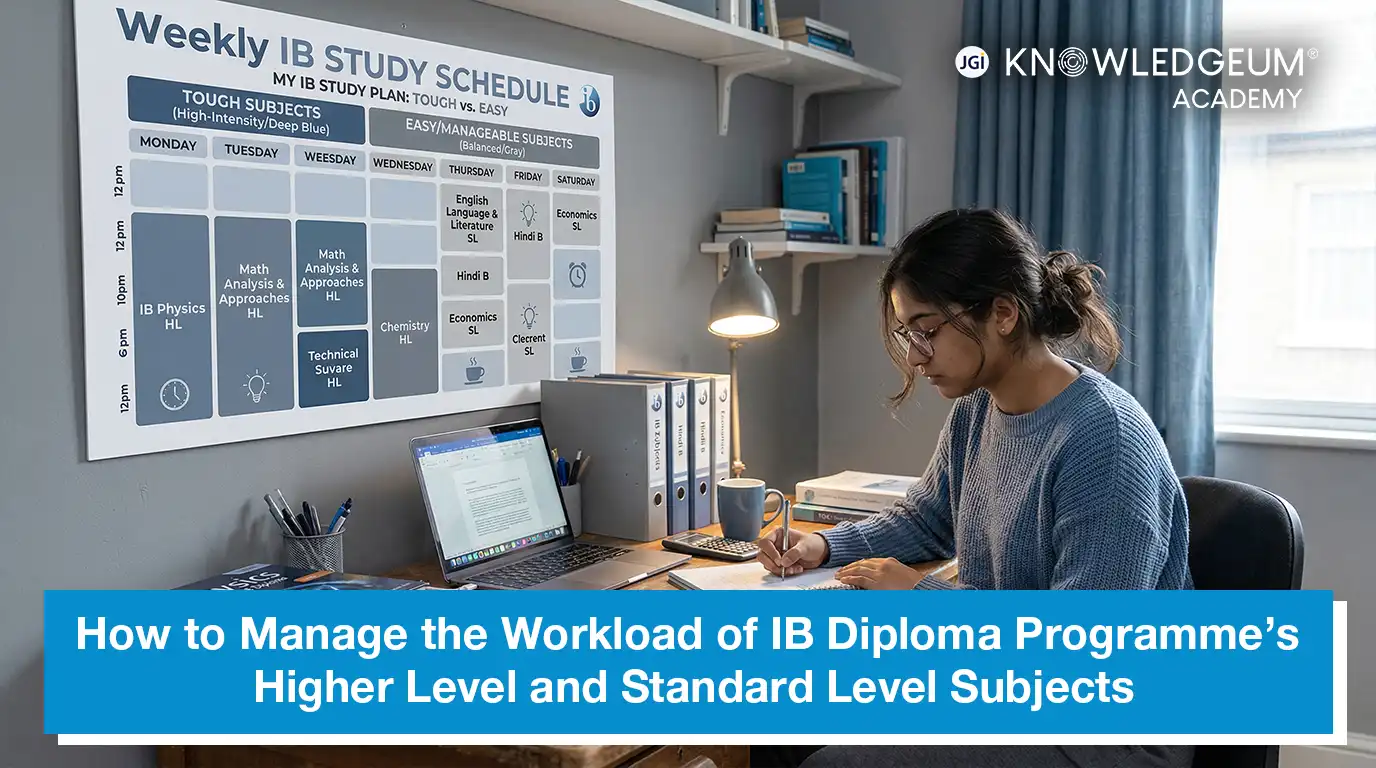
The IB Diploma Programme structure requires you to take a combination of Higher Level and Standard Level subjects alongside DP core elements like Theory of Knowledge, Extended Essay, and Creativity, Activity, Service. To handle this course load, it is important to use active recall and an organised study routine for HLs and SLs without unnecessary stress. You can create a basic plan where you are targeting 20 to 30 hours of studying per week. Consider dividing it into two parts, with a minimum of 10-12 hours allocated for HLs and 6-8 hours set for SLs. Read on to understand how you can manage the workload of IBDP Higher Level and Standard Level subjects effortlessly:
The International Baccalaureate Diploma Programme is a pre-university course offered by the International Baccalaureate. The IB curriculum is meant to be a challenge on an academic as well as personal level. There are six different subjects, with three usually at Higher Level and three at Standard Level. Apart from these, the three DP core components are also also essential parts of the programme, with CAS activities spread over the year.
Each HL requires about 240 teaching hours, while each SL involves about 150 hours. That is why HLs can feel so much more taxing at times. However, the trick to getting through all this without getting overwhelmed is to realise that not all courses require the same level of attention at all times.
HL subjects go deeper into concepts and often involve complex assessments. Whether it is HL Mathematics, Biology, or History, they require greater analytical depth and conceptual understanding. The HLs you choose influence which courses you can opt for at the university level. Therefore, it is expected that your HL focus is consistent and thorough.
Standard Level subjects are not easy subjects just because they have fewer teaching hours. They still require good understanding, though not as in-depth as the HLs. It is recommended not to take SLs for granted and then end up studying at the last minute. Ensure you are giving enough time to revise SLs and work on weaknesses.
The IB Diploma Programme is not just about exams. Internal assessments, oral presentations, lab reports, and essays are constantly building up over two years. Then, of course, there are things like the TOK Exhibition and Extended Essay to factor in as well. You need a system to manage all the deadlines and ensure weekly study sessions progress smoothly without creating any backlog.
In IB, time management is not just about studying hard; rather, it is about studying smart. Begin with your framework where you chart out your fixed commitments, such as your school hours and extracurricular activities. Next, start by scheduling study sessions in the remaining time.
Prioritise your HL subjects, as these need slightly more time than SLs. For example, if you are setting three hours aside for studies, then spend 60% of your time on your HL subjects. This way, you are consistently improving your concepts rather than relying on last-minute preparation before your exams.
For your SL subjects, spend less time but be consistent. Depending on your academic interests and strengths, decide how much time each SL subject would need.
It is not sufficient just to recall what you have learned when studying HLs. You need clarity in your concepts and analytical ability. Active recall, practising questions from previous years, and studying/revising in groups are very effective.
If you attempt tough exam questions weekly, you can reduce stress levels before exams. To pass HL exams, you need to recognise the pattern of questions and application. Study groups can be helpful as well. Explaining a concept like HL Physics to your friend will actually help you better understand it.
It is easy to ignore your SL subjects when the HL subjects get more demanding. This is, however, not advisable since your SL subjects are equally important in determining your final grade. They carry the same weightage as HLs. However, in HL, a 7 indicates higher academic achievement due to the increased difficulty and scope.
It is also advisable to start working on your internal assessments early to avoid last-minute pressure during your exams. You can start by making summary notes for your SL subjects to make revision easy.
Your IB journey is spread over two years. It is not a sprint where everything needs to be covered at the same time. So, consider proper sleep, exercise, and socialising as factors that prevent burnout and enhance productivity. Taking strategic breaks allows you to retain information more effectively.
When you feel stress mounting up, talk to educators and parents. Help is available for a reason. Learners who ask for help actually end up achieving better grades because they catch mistakes before they become major problems.
A digital planner like Trello, Notion or Google Calendar can be a game-changer. You can manage workflow without any hassle with such digital tools. Set reminders for your Internal Assessment deadlines or add time blocks for different subjects.
Consider using these tools to maintain an error log, as it will help you identify your academic weaknesses. You can understand where conceptual gaps are or which topics need more time to revise.
Managing HL and SL work in the IB Diploma Programme is completely doable with structure, clarity, and balance. By prioritising HL work strategically, keeping SL work steady, and taking care of yourself, this programme will be challenging and rewarding.
You can get in touch with the best IB schools in Bangalore, like Knowledgeum Academy, where academic counselling helps learners achieve their potential.
How do you manage your workload when studying? Do you have any tips that we have missed? Share with us in the comments section.
Most learners benefit from 2–4 focused study hours daily outside school.
Yes, slightly more time for HLs is advisable due to depth and university relevance, but SL subjects must remain consistent.
Ideally in the first year, so you avoid the stress during final exam preparation.
They are highly effective when focused on discussion and past paper analysis rather than passive reading.











 Brochure


Address
No.10, (old 271/A), 1st Main Road


Quick links
© Knowledgeum



 Knowledgeum Experience