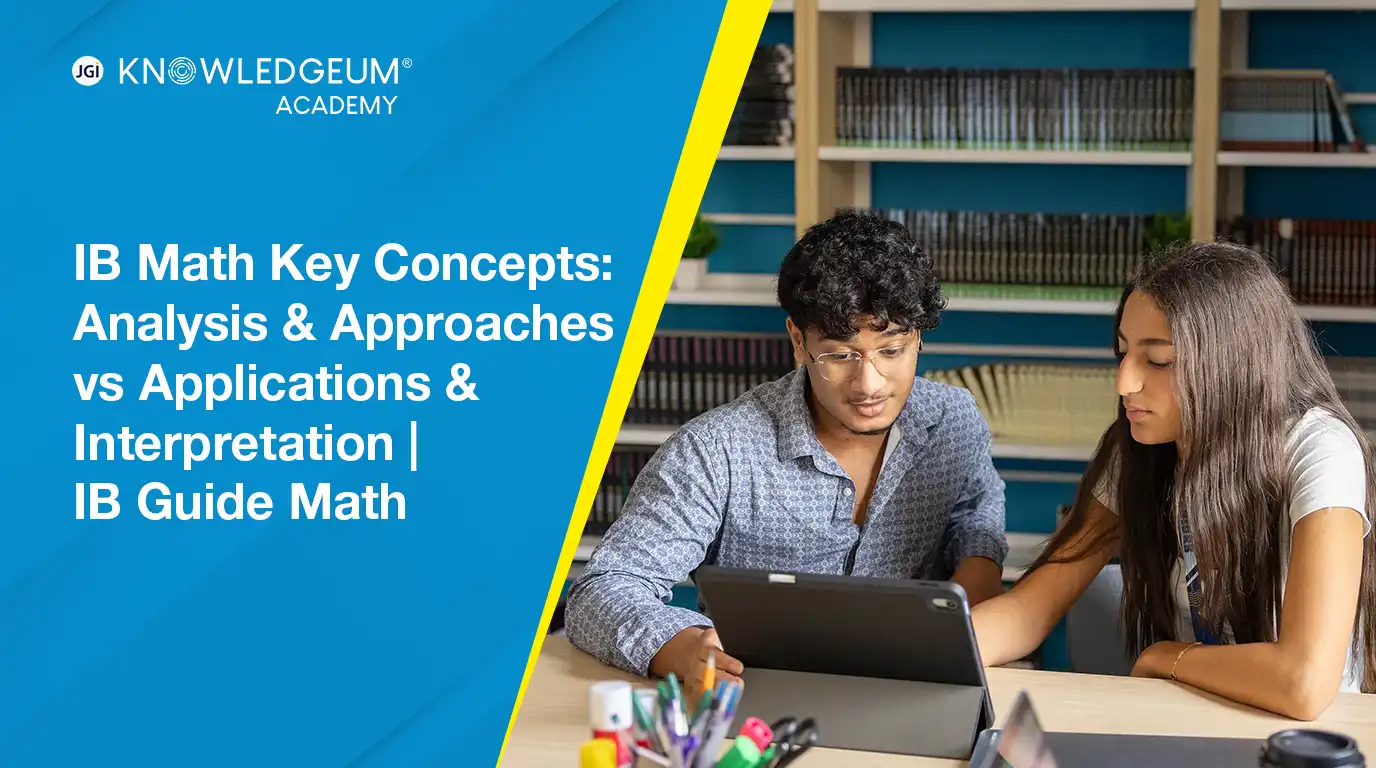
The International Baccalaureate Diploma Programme (IBDP) has two subjects in the Mathematics group – analysis and approaches (AA) and applications and interpretation (AI). IB Maths AA is focused on analytical methods with algebra and functions, geometry and trigonometry, calculus, and probability and statistics, whereas IB Maths AI is about data-driven problem-solving in real-life contexts. It includes statistics and probability, functions and technology integration, and financial Mathematics. This IB Maths guide includes the core Mathematical concepts in detail and focuses on the role of the graphical display calculator and how internal assessment approaches these subjects.
The IB Maths subject group is one of the main pillars of the IBDP curriculum. The learner may be interested in math-heavy fields like engineering or economics, or fields that are less focused on numerical analysis, like medicine or social sciences, but Maths will help develop critical thinking and problem-solving approaches.
Math AA is for learners who would love to explore pure Mathematics and theoretical problem-solving.
Math AI is for learners who are interested in the practical application of Mathematics in real-life contexts and data analysis.
Also read: What level of Maths should you choose in the IB?
IB Math AA is directed towards analytical expertise, where learners can communicate Mathematics clearly. It is important to know the detailed curriculum while selecting subjects for IBDP. The core Mathematical concepts in IB Maths AA include thorough exploration and understanding of Maths topics like Calculus, Functions, Geometry and Trigonometry.
Number and Algebra: It introduces learners to the structure of series, equations and sequences. Learners are required to achieve logical reasoning in order to simplify Mathematical expressions.
Calculus: It is one of the most important areas of IB Maths AA where limits, derivatives, integrals, and differential equations are introduced. The analytical skills developed through this are necessary for fields like physics, engineering, and Mathematics.
Geometry and Trigonometry: This is about the fundamental concepts of 3D and coordinate geometry along with trigonometric functions and equations.
This area covers vectors, coordinate geometry, and trigonometric identities. It emphasises logical reasoning and precision in abstract problem-solving.
Probability and Statistics: This section is covered thoroughly in Maths AI, but AA helps learners understand theoretical foundations rather than applied use.
GDC stands for the Graphical Display Calculator and is an important tool for IB Math learners. Even though learners are expected to use manual derivations and proofs, GDC in IB Math AA supports a variety of functions.
GDC is helpful in calculus, as it can be used for finding areas under curves and solving equations. GDC is also used in statistics for finding probabilities, correlation, coefficients, and performing statistical analysis
However, learners are required to master and show Mathematical reasoning and analytical methods without depending excessively on calculators.
IB Maths AI was created after recognising the increasing role of Mathematics and technology in life, and people are encouraged to find solutions through the application of Maths. The core Mathematical concepts in IB Math AI are –
Statistics and Probability: This topic is critical for learners who want to pursue fields like economics, psychology, and business, as it includes study of descriptive statistics, regression analysis, probability distributions, and hypothesis testing
Mathematical Modelling: learners are expected to construct, test, and refine models to interpret real-world scenarios. It can include climate data, financial trends, population growth, or economic shifts.
Functions and Technology Integration: The GDC plays an important role in this topic as AI teaches how technology can analyse complex data. It also includes practising graphing and numerical solutions.
Financial Mathematics: This topic is specifically covered in AI and has a focus on loans, interest rates, and other financial concepts for learners who are preparing to have a career in business, finance, or applied economics.
Unlike AA, the GDC plays a central role in AI. Learners use calculators extensively for:
GDC can be used to graph functions, which allows learners to visualise Mathematical relationships easily.
GDC is useful in statistical calculations, as it can help with finding means, standard deviations, and generating statistical diagrams.
When it comes to financial modelling, GDC’s built-in financial functions, like Time Value of Money (TVM) solvers, ensure ease of use for learners.
The IB encourages AI Maths learners to integrate technology into almost every aspect of their work so that they can get familiar with real-world Mathematical applications.
The role of IB Maths is to develop curiosity and knowledge of the subject. The internal assessment (IA) model encourages learners to explore the subjects without the constraints that come with traditional written exams. The IA criteria are the same for both AA and AI.
| Feature | Math AA (Analysis & Approaches) | Math AI (Applications & Interpretation) |
| Focus | Abstract, theoretical Math | Applied, real-world contexts |
| Core Strength | Algebra, Calculus, Proofs | Statistics, Modelling, Technology |
| Use of GDC | Supportive role | Central role |
| IA Style | Analytical, theoretical explorations | Practical, data-driven projects |
| Best Suited For | STEM careers | Social sciences, business, applied fields |
Both Applications and Interpretation and Analysis and Approaches help learners develop problem-solving skills. AA is perfect for those who want to pursue careers in STEM, whereas AI is for social sciences, economics, or business fields. It is easier to decide which Maths subject to choose and at which level after understanding the details. It is time to learn how to communicate Mathematics effectively and appreciate how Maths and technological developments are shaping the world today.
Would you like to know how Knowledgeum Academy explores the IB Maths curriculum? Get in touch with us!
The main difference between them is that IB Math AA is about abstract and theoretical Mathematics, whereas IB Math AI is about practical, real-world applications.
The IB Maths AA is recommended for those who want to pursue engineering, as it builds a strong foundation in calculus and algebra.
Yes, IB Math AI students can pursue STEM careers, but AI may not offer the theoretical depth of AA.
The Graphing Display Calculator (GDC) plays a supportive role in IB Maths AA and is a central learning tool in IB Maths AI. In AA, it’s supportive. In AI, it’s central to learning and assessment.









How to Manage the Workload of IB Diploma Programme Higher Level and Standard Level Subjects





 Brochure


Address
No.10, (old 271/A), 1st Main Road


Quick links
© Knowledgeum



 Knowledgeum Experience