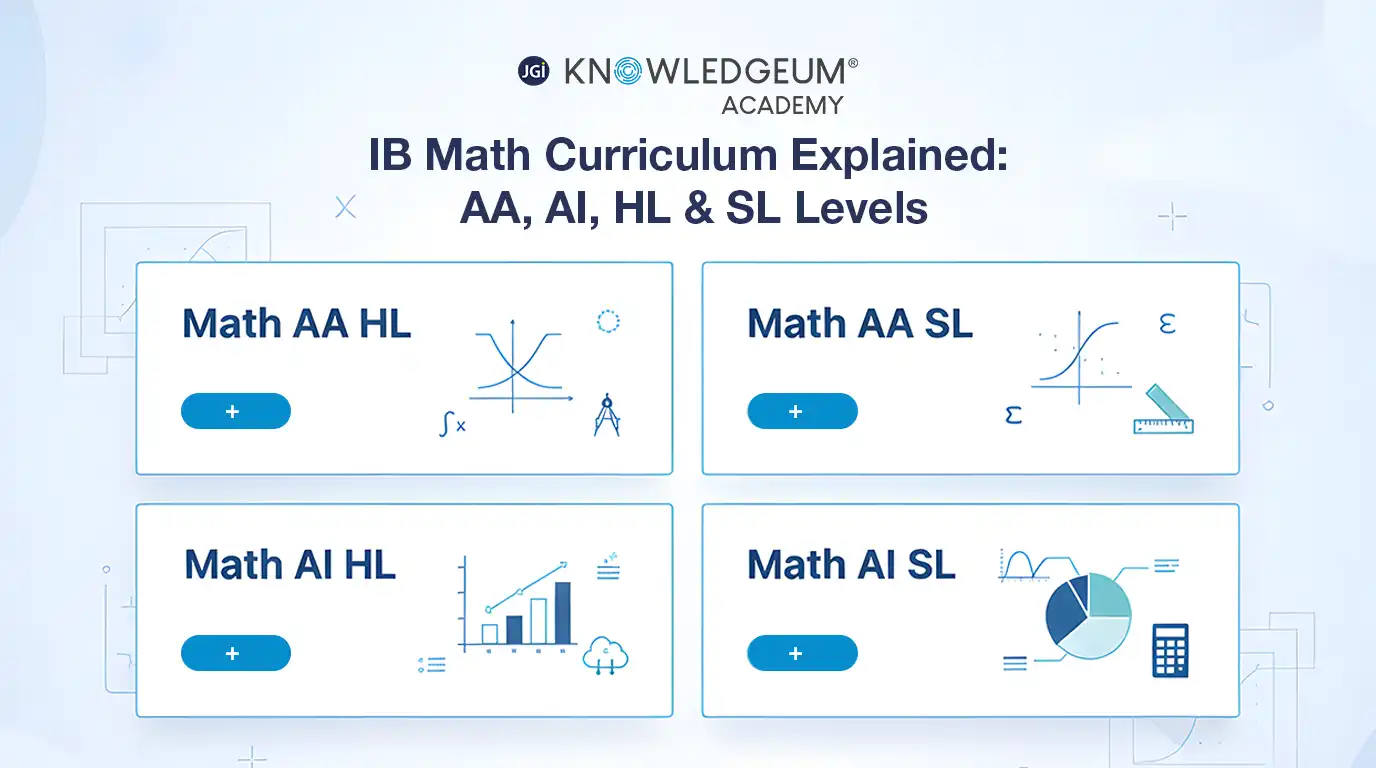
IB Math AA is best for STEM and theory-heavy degrees, while AI suits data-driven and applied fields. HL is preferred by selective universities; SL works for non-STEM paths.
Choosing the right IB Maths subject and level can feel overwhelming, especially because universities often use these choices to assess academic fit. In the IB Diploma Programme, students can pick between Mathematics: Analysis and Approaches (AA) and Mathematics: Applications and Interpretation (AI), each offered at Higher Level (HL) or Standard Level (SL). AA is more calculus-based and suited for STEM pathways, while AI focuses on statistics, modelling, and real-world applications. This guide explains IB Math AA vs AI, HL vs SL, which course is best for whom, and how universities evaluate them.
Analysis & Approaches (AA) covers the pure Math curriculum. It includes algebra, functions, trigonometry, series, and calculus. The focus is on proof-style reasoning and rigorous topics. Interested in the STEM field? Choose AA as it prepares them for university-level subject depth. It is necessary to opt for AA HL for such courses.
Applications & Interpretation (AI) is known for combining Maths with real-world problems and solutions. The AI syllabus includes modelling, statistics, probability, and technology-driven explorations, usually based on real-world data. AI HL is an ideal choice for data-centric fields like Business Analytics, Psychology, Economics, and Data Science. If you do not have a strong interest in STEM, prefer IB Math AI SL as it introduces the lighter Maths topics like modelling, functions in context, statistics, and introductory calculus.
IB Mathematics HL is about more content depth, a faster pace, and extended topics that include advanced calculus, series, probability in AA or matrices in AI. It depends on which course you opt for. It is recommended to choose Maths HL if you need a strong foundation for your preferred university and career goals.
IB Mathematics SL also covers core Maths topics, and they are taught in depth, but as it includes fewer extensions, it is a great choice if Maths is not the focus of your academics. You can opt for IB standard-level Maths if you are balancing your HLs in other subject groups and plan to pursue a career outside of STEM.
The official IB curriculum guide recommends 240 hours of teaching for Maths HL and 150 hours of teaching for Maths SL.
| Feature | AA SL | AA HL | AI SL | AI HL |
| Focus | Calculus, algebra, functions | Advanced calculus, proofs, complex theory | Statistics, modelling, technology use | Advanced modelling, simulations, deeper statistics |
| Best for | General science pathways | STEM degrees, engineering, physics | Business, psychology, design | Data science, analytics, some Economics |
| Difficulty | Moderate–high | Very high | Moderate | High |
| University preference | Required for math-related fields | Strongly preferred for STEM programmes | Accepted for social sciences/business | Preferred for analytics and data-heavy courses |
| IA Exploration | Application of theory | In-depth mathematical investigation | Real-world datasets & interpretation | Complex modelling or optimisation |
| Calculator dependency | Low–moderate | Low | High | High |
Still feeling torn between Maths subjects and Maths HL or SL? Here is the visual flowchart to help you decide at a glance which Math subject to choose for your IB Diploma Programme without going into details –
Start
├─ Do you enjoy abstract Algebraic manipulations and proofs?
│ ├─ Yes → Prefer AA
│ └─ No → Prefer AI
└─ What do your target majors require?
├─ Math/Physics/Engineering (theoretical), some CS → HL (ideally AA HL)
├─ Data Science/Economics/Business Analytics → HL (AA or AI; many accept AI HL)
└─ Business/Design/Humanities/Arts → SL is usually sufficient (AA SL or AI SL)
Here are some of the important AA HL topics covered in the syllabus. The sequence of these topics may differ from school to school, but the subject focus remains the same.
Algebra & Number provides in-depth knowledge of sequences/series (including sigma notation), the binomial theorem, and complex numbers.
Calculus HL focuses on topics like limits, continuity, differentiation (implicit/parametric), optimisation, related rates, integration (techniques, volumes), and differential equations.
Functions & Graphs is where polynomial, rational, exponential, logarithmic, and inverse functions and transformations are covered.
Trigonometry has areas like identities, equations, proofs, triangle solutions, and polar connections.
Vectors & Geometry is for vector operations, lines/planes in 3D, and geometric reasoning.
Proof & Reasoning includes induction/proof strategies and the structure of arguments.
It is necessary to keep in mind that AA SL is a challenging course. It covers core IB standard-level Math essentials with appropriate breadth. Here is how the key AA SL topic list differs from AA HL -
Functions & Algebra has core function types, transformations, and solving equations.
Trigonometry covers basic identities, equations, and applications.
Calculus is about differentiation/integration basics and optimisation in context.
Probability & Statistics has descriptive stats, distributions, and an intro to inference appropriate for the SL syllabus.
Here are some of the IB HL Maths topics for AI that keep this course ideal for data-heavy fields. These key AI HL topics include -
Modelling with Functions, where you learn to choose/validate models along with residuals and error.
Statistics & Probability is where distributions, sampling, inference (confidence intervals, hypothesis testing), regression (linear/multiple), and time-series features are covered.
Calculus in Context covers rates of change, optimisation, and integration for accumulation that is driven by real data. Keep in mind that the topics covered in AI HL are less extensive than in AA HL.
Technology & Coding is focused on learning to use a GDC and software/spreadsheets. It also shapes algorithmic thinking.
The focus of the IB SL Math topics is to foster a problem-solving attitude through modern data skills. The key AI SL topic list includes:
Descriptive Statistics is all about centre, spread, visualisations, and correlation vs causation.
Probability Basics has conditional probability and discrete distributions.
Modelling explores linear and exponential power models as well as validation and residual analysis.
Introductory Calculus covers derivatives and integrals in real contexts.
Financial Math ensures understanding of interest, annuities, and shortest paths.
Technology is about GDC/spreadsheet workflows and interpreting outputs.
STEM and quantitative majors – Many universities for Maths, Physics, and Engineering courses need AA HL as it helps create a solid foundation for calculus and develop proof skills.
Computer Science – There are some CS programmes that accept AI HL. However, AA HL will help open more doors and create a strong impression in university applications.
Economics – Many universities accept AI HL for economics; however, mathematically rigorous economics programmes may prefer AA HL. It includes data-oriented topics as well as theory-based knowledge. For more on suitable IB subject combinations, check IB subject combinations for Economics.
Business, management, and finance – AI HL is easily accepted at these courses, and AA SL/HL is also welcomed. A few departments may demand AA HL for the theoretical purpose, so confirm the university requirements.
Humanities, arts, and architecture – Almost all the non-STEM courses are okay with AA or AI SL, but some architecture programmes may prefer HLs. For such courses, AA SL is the safe choice, leaving different career paths open.
The easiest way to pick an IB Maths level is to consider three factors – your academic strengths, interests, and university requirements. You can check if AA or AI is required at your choice of university for the course you are interested in and confirm if it is preferred at HL or SL. Use the flowchart given above, talk to the school coordinators if needed, and lock in the Maths subject that is best suited.
Still unsure whether AA or AI is right for your academic goals? Knowledgeum Academy provides dedicated counselling to help you select the optimal IB Maths level based on your university ambitions.
Reach out to us to learn more about the IB curriculum and make an informed choice.
Generally, AI is easier for students who enjoy practical problem-solving, statistics, and real-world modelling. AA is more challenging because it focuses on algebra, calculus, and abstract reasoning.
Yes, AI SL covers modelling and statistics that business and design courses require. But a few global universities may need AA SL or AI HL, so check the requirements.
Most competitive Computer Science programmes prefer AA HL because it includes advanced calculus and proofs. However, some universities accept AI HL, especially for software-focused or interdisciplinary CS degrees. Always check individual programme requirements.
AA HL is ideal for economics programmes that are focused on the theoretical part, and AI HL is for data-centric courses. Consult course requirements and a counsellor; AA HL is the safer choice for mathematically intense degrees.
Most schools allow switching in the first few months of Grade 11.
Switching later is difficult because AA and AI cover different foundations. Moving from SL to HL may also require catching up with additional content.
Architecture is not always a math-intensive major, but several universities prefer or recommend AA SL or AI HL because of geometry, modelling, and analytical skills. Requirements vary widely.
For Data Science, AI HL is an excellent choice because it includes statistics, modelling, regression, and real-world data interpretation.
But if the degree has a strong mathematical/ML theory component, AA HL may be preferred.
Yes—HL can strengthen your application even for non-STEM fields because it demonstrates academic rigour.
However, it should not compromise performance in your other HL subjects or overall workload.







How to Manage the Workload of IB Diploma Programme Higher Level and Standard Level Subjects

 Brochure


Address
No.10, (old 271/A), 1st Main Road


Quick links
© Knowledgeum



 Knowledgeum Experience