When the matter is about one’s child’s education, especially in high school, when they are at the critical threshold of entering college, choosing the right education board can define the narrative of the child’s future. Cambridge’s IGCSE and India’s CBSE are widely popular and have distinct advantages. Both boards follow different approaches to learning, though they maintain a strong focus on STEM. The Pre-university courses (PUC) offered by CBSE and Cambridge prepare students for college programmes by laying a strong academic foundation through lessons in important theories and concepts in every subject. Even the subject selection in the programmes adheres to the criteria for college admission requirements.
|
Cambridge vs. CBSE |
||
|
Parameters |
Cambridge |
CBSE |
|
Curriculum |
PUC in IGCSE is divided into AS and A levels (which are 11th and 12th grades respectively). Students must take at least 3 subjects from its 5 subject groups to earn their A-level certification. |
CBSE has three branches - Science, Commerce and Humanities and there are subject combinations within each of the branches. English and a second language are the compulsory subjects for all three branches. |
|
Assessments |
- Periodic Assessments - CAIE administers evaluations after IGCSE, AS and A Level). All other evaluations are done at the school level. - Extended-response questions in written assessments |
- Ongoing assessments with one external written exam administered by the CBSE Board. - Internal assessments in the form of experiments and projects. - The final assessment paper will have multiple-choice questions, short-answer questions, and extended-response questions. |
|
Skill development |
Academic research, critical thinking, use of technology, international mindedness |
Conceptual clarity, singular focus on the subject |
|
Recognition |
Cambridge’s IGCSE has international recognition and qualification equivalent to the UK's General Certificate of Secondary Education (GCSE). |
CBSE is India’s national-level board which has country-wide recognition. Most international colleges accept it. |
IGCSE has 5 main disciplines -
Students must choose at least one subject from all five disciplines. English and Mathematics are compulsory subjects that all students must take. To earn the IGCSE A Level certificate, the student must study at least five subjects.
CBSE 12th Board or PUC course is divided into three main streams -
English and a second language (such as Hindi, Sanskrit, Kannada, or French) are compulsory in all three streams. Under each of the stream, students can opt for subject combinations to study. Each subject combination will have four subjects. So, altogether a student will take six subjects in the 12th grade.
IGCSE offers greater curriculum flexibility by giving students space to choose interdisciplinary subjects. This is beneficial to the students as many international colleges prefer students who have a breadth of knowledge and skills beyond their chosen field. CBSE’s standardised approach is useful to students who are focused on their goals and want to prepare for them alone. Both courses are focused pre-university programmes that prepare students with academics and skills for college education. CBSE has one project or laboratory experiment as an internal assessment and end-of-the-year Board exams. IGCSE focuses on experiential learning where students are continuously engaging with the subject through assignments, projects, experiments and the final year written assessment.
The IGCSE curriculum is suited for students who want to study in foreign colleges or any top Indian college. It prepares students with important skills for college education. India’s competitive entrance tests for professional courses such as CET, IIT- JEE, NEET etc. are all based on the CBSE syllabus. Thus, it is easier for students to prepare for these tests as they already have a foundation in the topics. Though both boards take different approaches, there is scope and potential for growth in both cases.
If you are looking for an international education board for high school, the IB is also a great alternative. It has two courses, the IB Diploma Programme (IBDP) and the IB Career-related Programme (IBCP). The IBDP is an academically driven interdisciplinary programme that prepares students for college education. IBCP is a career-centric programme with the academic learning of IBDP. Students can choose either course depending on their learning style and career interests. IGCSE, CBSE, IBDP and IBCP enjoy recognition from the majority of international colleges.







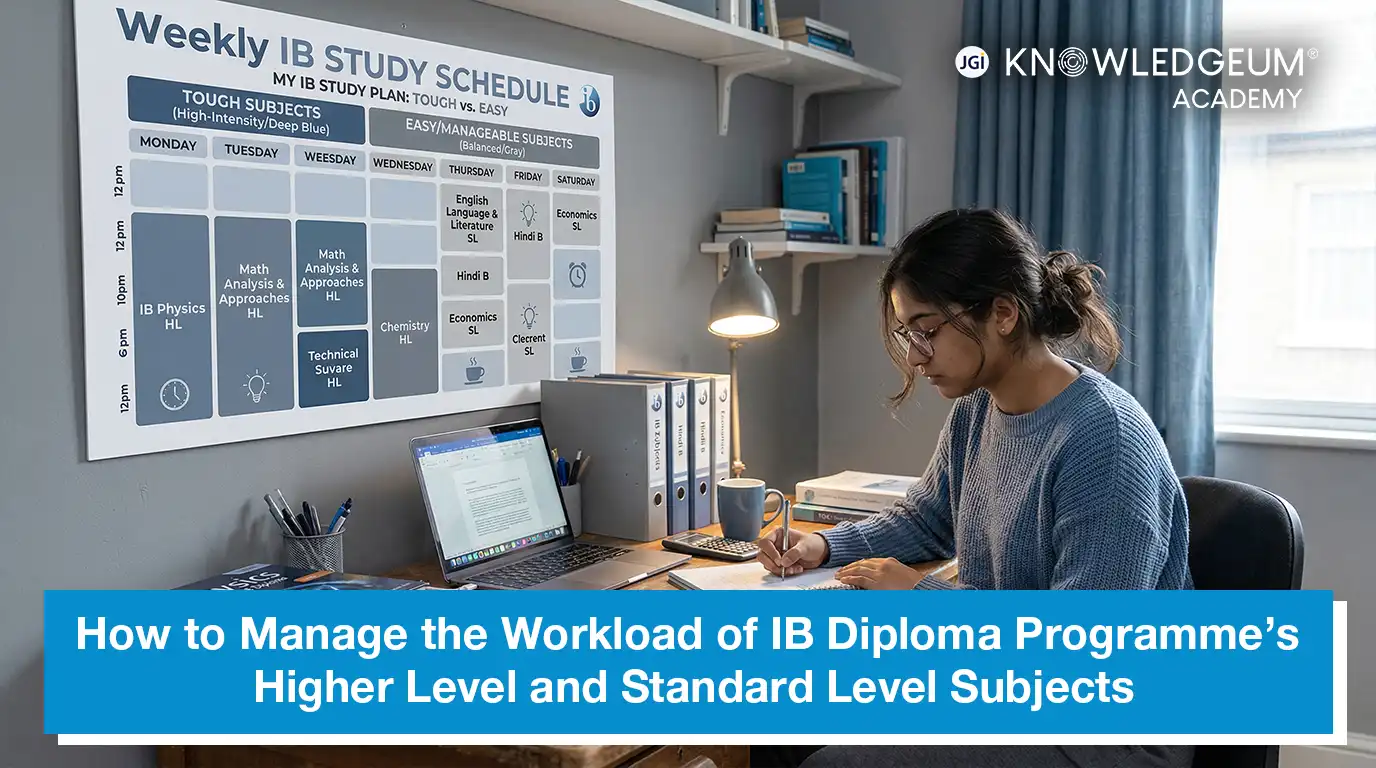
How to Manage the Workload of IB Diploma Programme Higher Level and Standard Level Subjects


 Brochure


Address
No.10, (old 271/A), 1st Main Road


Quick links
© Knowledgeum


 Knowledgeum Experience